





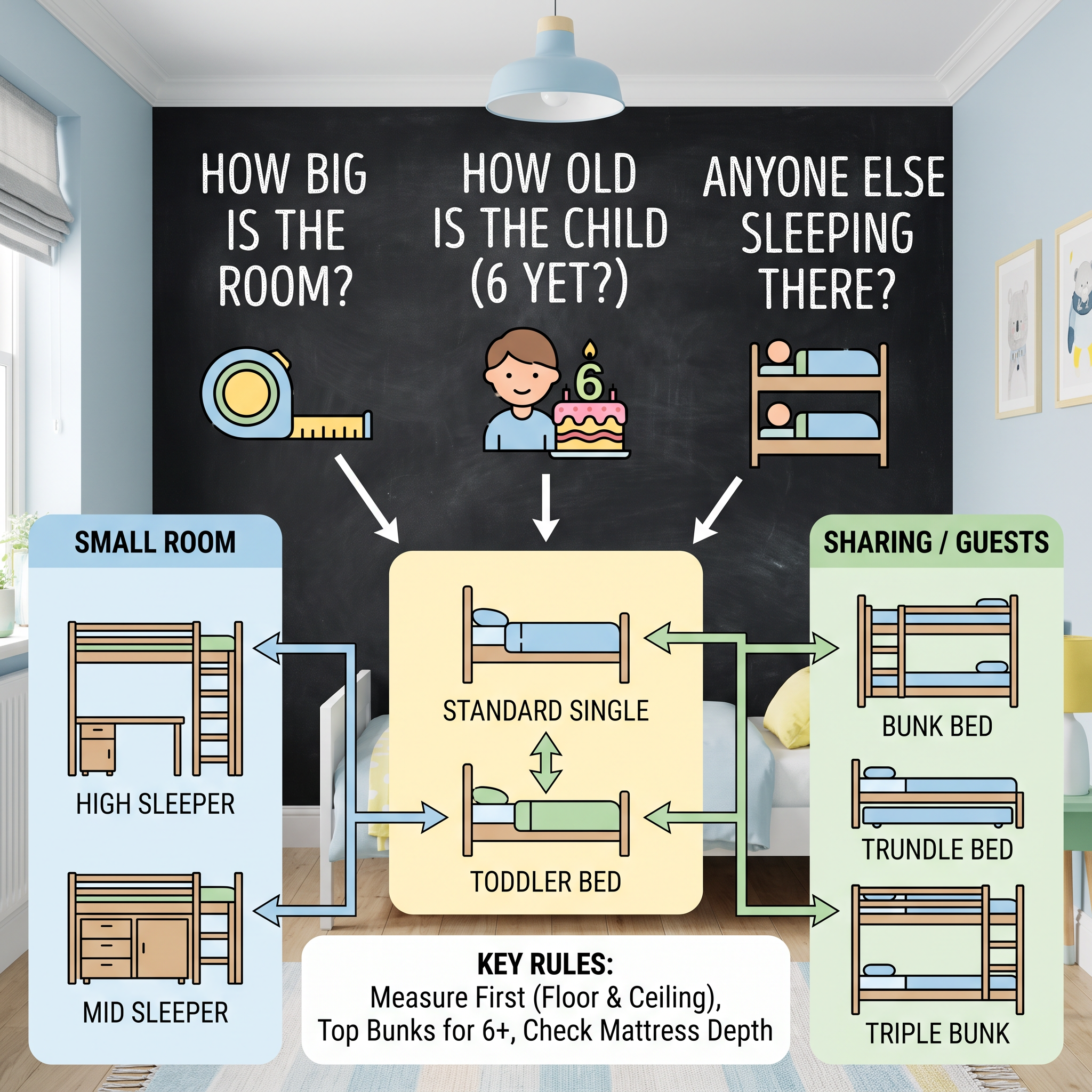
Three questions decide this, and none of them is about style.
-
How big is the room?
-
How old is the child, and are they six yet?
-
Does anyone else need to sleep in there?
Answer those and the shortlist is usually two or three beds. Everything else is preference.
Start with the room
Measure before you look at anything. Two numbers matter:
Floor space. A standard single bed is 190 x 90cm and should have at least 60 cm clearance around it for safety. In a typical UK box room at roughly 2.1 x 3m, a bed plus a wardrobe and a chest of drawers leaves almost no floor left.
Ceiling height. This decides whether a raised bed is even possible. Your child needs to sit up on the top surface without their head near the ceiling. For a full-height high sleeper, allow at least 2.3m. Sloped ceilings and loft conversions usually rule them out.
If floor space is the problem, go up. If ceiling height is the problem, stay low and use storage instead.
The age rule that governs everything
The top bunk of a bunk bed, and the sleeping platform of a high sleeper or mid sleeper, are for children aged 6 and over.
This is set by BS EN 747, the British standard for bunk beds and high beds, and it isn't a guideline you work around. It exists because coordination and night-time awareness develop significantly between four and seven, not because six is a magic number.
Under 6, that leaves floor-level beds, toddler beds, and the bottom bunk of a bunk bed. Which is plenty.
Matching the bed to the situation
One child, small room, aged 6+
A high sleeper is one of the biggest single gains you can make; unlike bunk beds, which save space by stacking beds vertically, it creates usable room underneath for one child. The bed goes up, and you get a desk, a wardrobe or a sofa bed underneath in the same footprint. It effectively doubles a small room, creating more usable sleeping space.
Our best sellers here are the ones with a sofa bed underneath, because they solve two problems at once: the room works during the day, and a friend can stay over without a spare bed.
Browse high sleeper beds or read our full high sleeper guide.
One child, small room, under 6
A mid sleeper or cabin bed. Raised enough to fit drawers and storage underneath, low enough to be sensible for a younger child. This lower-profile style can also suit children aged 5-9 who are ready for a low loft-style setup. Less dramatic than a high sleeper but it does the same job at a fraction of the height, making it a practical option for smaller rooms.
Two children sharing a bunk bed
A bunk bed, and the choice within that often depends on ceiling height, the younger child's age, and whether they're sharing with older siblings.
-
Standard bunk if both are 6+ and the ceiling allows it
-
Low bunk if the ceiling is low or sloped, or the younger child is under 6 and will be on the bottom—the perfect solution where ceiling height is limited. See our guide to low bunk beds
-
Bunk with a trundle if there's a third child, or sleepovers happen regularly
-
Triple bunk or family bunk for three, or where the bottom bunk needs to be a small double
One child, but friends stay over
A guest bed with a trundle. Looks like a single bed, pulls out into two. Takes up one bed's worth of floor space the rest of the time, which is the whole point.
Moving out of a cot
A toddler bed, typically 70 x 140 cm, is low to the floor with side rails for toddlers, or you can go straight to a standard single if the room allows. For many parents, moving their little one into a new bed happens around age 3, often when they start climbing out of the crib. Toddler beds are commonly used by children aged 2-4 as a transitional step. Plenty of families skip the toddler bed entirely and use a single with a guard rail, which saves a purchase.
Teenagers
The requirements change. Desk space matters more than play space, and a continental single at 90 x 200cm gives an extra 10cm of length that growing bodies will use; for older kids not ready for that jump, a larger bed is not always necessary, as a junior bed usually measures 80 x 160cm and can often be used until about age 8.
A high sleeper with a full-width desk works well here, and so does a standard single with proper storage. See our guide to teenage beds for small rooms.
When not to buy a raised bed
Worth saying, because it's the mistake we'd rather you didn't make.
-
The child is under 6. No exceptions on the top surface.
-
The ceiling is under about 2.3m, or sloped above where the bed would go.
-
Check the bed frame meets UK safety standards for children's bedframes and uses sturdy materials for a secure child's bed.
-
Choose non-toxic finishes too, because rules on children's furniture also cover toxic materials, and rounded edges on the bed frame help protect your child's safety by reducing knocks and injuries.
-
Your child sleepwalks, or has coordination or balance difficulties.
-
You'll be making the bed daily. Changing sheets on a top bunk is genuinely awkward, and it's the complaint we hear most from parents who didn't think about it beforehand.
-
The room is big enough already. If floor space isn't the problem, a raised bed adds height and complication for nothing.
Bed sizes
|
Size |
Dimensions |
Typical age |
|---|---|---|
|
Cot bed |
70 x 140cm |
Up to 4 or 5 |
|
Shorty single |
75 x 175cm |
4 to 8 |
|
Junior bed |
80 x 160cm |
Up to age 8 |
|
Small single |
75 x 190cm |
4 upwards |
|
Standard single |
90 x 190cm |
6 upwards; the same size many parents think of as a twin bed |
|
Continental single |
90 x 200cm |
Teens |
|
Small double |
120 x 190cm |
Teens, or sharing |
Moving up to a larger bed often makes sense once your child's development and room size support it.
More detail in our kids' bed size guide.
Don't forget the mattress
Two things catch people out when choosing the right mattress, and both cost money to fix afterwards.
Depth. Bunk beds and high sleepers have a maximum mattress depth, usually 15 or 16cm. Guard rails are designed to sit a set height above the mattress. Most high-street singles are 20cm or deeper, which removes that clearance. The mattress for your child should also fit snugly within the frame, as gaps can affect safe sleep and create an entrapment risk. Our bunk bed mattresses are built at 15cm for this reason.
Quantity. A bunk needs two. A bunk with a trundle needs three, and the trundle usually takes a shallower mattress again, around 10cm, so it clears the frame when it slides away.
For most young children, a medium firm or firm mattress is the best mattress option because it gives proper support, helps spinal alignment and eases pressure points. In practice, a medium-firm feel is usually best for a child's sleep and can help deliver a comfortable night's sleep.
A pocket sprung mattress gives independent support and can spread a child's weight evenly, while memory foam can contour more closely to the body. A breathable memory foam mattress may suit some families, but the right mattress still needs to match the bed type and depth limits.
A high quality mattress will last better, and a mattress protector, ideally waterproof, helps if a child wets the bed and keeps the child's mattress hygienic. If your child has allergies or sensitive skin, a hypoallergenic child's mattress can be a sensible choice for a good night's sleep.
See our kids' mattress range, or read the kids' mattress guide.
Before you order
-
Measure the room, including ceiling height directly above where the bed will go.
-
Check the ladder projection. On some beds it adds to the length rather than the width, and it isn't always in the headline dimensions.
-
Check access. Beds arrive flat-packed in several long boxes. Worth a thought if you've a tight turn on the stairs.
-
Plan the assembly. Most raised beds need two adults and one and a half to three hours. We offer assembly if you'd rather not.
-
Order the mattresses at the same time. Check each one matches the bed exactly for a snug fit, which helps prevent gaps that can cause entrapment.
-
Leave enough clearance around the bed and position it safely within your child's room.
-
Top tips: involve your child in choosing between the suitable options, as this can help make bedtime routines easier.
If you're stuck between two options, message us. We'd rather spend five minutes helping you choose than have the wrong bed delivered.
Common questions
What age can a child have a bunk bed?The bottom bunk suits most ages. The top bunk is for children aged 6 and over, set by BS EN 747.
What's the difference between a high sleeper and a mid sleeper?Height. A high sleeper is high enough for a desk, wardrobe or sofa bed underneath. A mid sleeper is lower, with room for drawers and storage but not a full workspace.
Is a high sleeper worth it in a small room?It's the single biggest gain available, provided the ceiling allows it and the child is 6 or over. You get the floor space back.
How much ceiling height do I need?At least 2.3m for a full-height high sleeper. Measure directly above where the bed will stand, and make sure a child can sit up on the top without their head near the ceiling.
Should I buy a bed that grows with my child?Where you can. A detachable bunk splits into two singles. A standard single with storage lasts from about six through to the teens. Both save a purchase later and are often the right bed for growing bodies, supporting a better night's sleep over more years.
What mattress do I need?Match the size to the bed exactly. On any raised bed, check the maximum depth first, usually 15 or 16cm. See our kids' mattress guide for more advice on choosing the best mattress and firmness.


