


A high sleeper is one of the best beds for a small room. It lifts the bed up and turns the floor underneath into usable space for a desk, a wardrobe, a sofa bed or a gaming setup, so a box room can do the job of a much bigger one.
Before you choose one, one rule and two measurements decide whether it will work: your child's age, the headroom above the mattress, and the mattress depth. We'll cover those first, then what can go underneath, and when a high sleeper isn't the right answer.
On this page
The rule: 6 and over
The sleeping platform of a high sleeper is for children aged 6 and over. That's the guidance in BS EN 747, the British standard for bunk beds and raised beds, and it doesn't change with a lower frame.
It exists because coordination, spatial awareness and the ability to respond safely when disorientated at night all develop a great deal between the ages of four and seven.
If your child is under 6, a low cabin bed or a bed with storage gives you storage in the frame with no climbing. That's the right product for now, rather than a lower raised bed. Mid sleepers are for 6 and over too.
The two measurements
- Headroom above the mattress. Your child needs to sit up on the bed without their head near the ceiling. Measure from where the top of the mattress will be to the ceiling, directly above where the bed will stand: a younger child needs roughly 70cm, and a teenager 80 to 90cm. Take care with sloping ceilings. If headroom is tight, the Mini Highsleeper puts the platform at about 110cm, around 30cm lower than a standard high sleeper, and still fits a wardrobe and desk underneath.
- Mattress depth. High sleepers have a maximum mattress depth, usually 15 or 16cm, because the guard rail height is measured from the top of the mattress. Most high-street single mattresses are 20cm or deeper, which lowers the rail's effective height by 5cm or more. Our bunk bed and high sleeper mattresses are made at 15cm for this reason. Most high sleepers take a standard single, and some take a longer continental single, which suits a tall teenager.
What goes underneath
This is the real decision. The bed on top is broadly the same; what changes is the space below it, and how well it will keep working as your child grows.
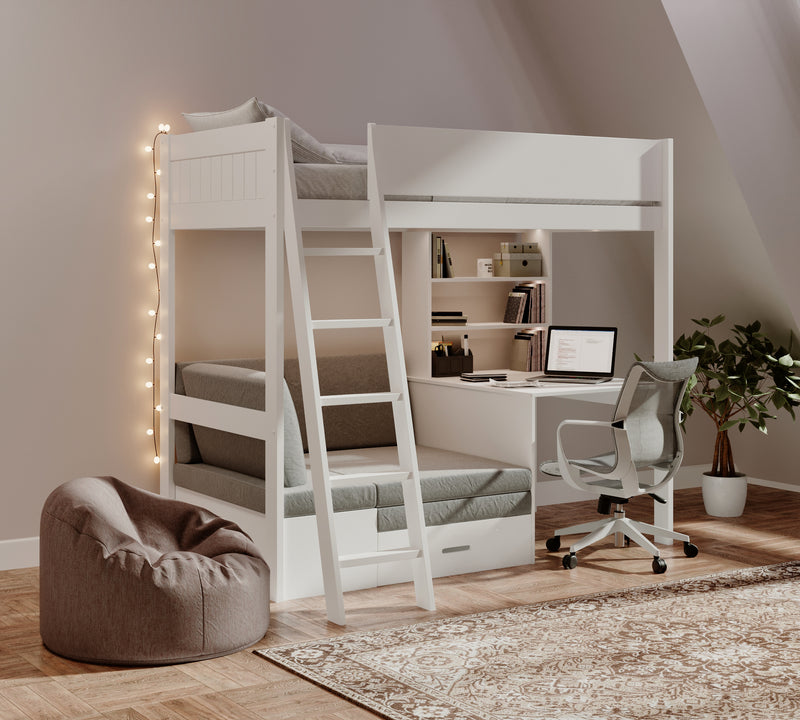
By far our most popular
A sofa bed
The space underneath becomes a small sofa that folds out into a bed: somewhere to sit during the day, and a spare bed when a friend stays. Most families choose this, and the reason is social rather than practical. A bedroom where friends can sit down is a different room from one that's only for sleeping, and it still works in the teenage years.
The Windsor is our best-selling high sleeper, and the Oxford and Chelsea pair a sofa bed with a desk too. See all high sleepers with sofa beds.
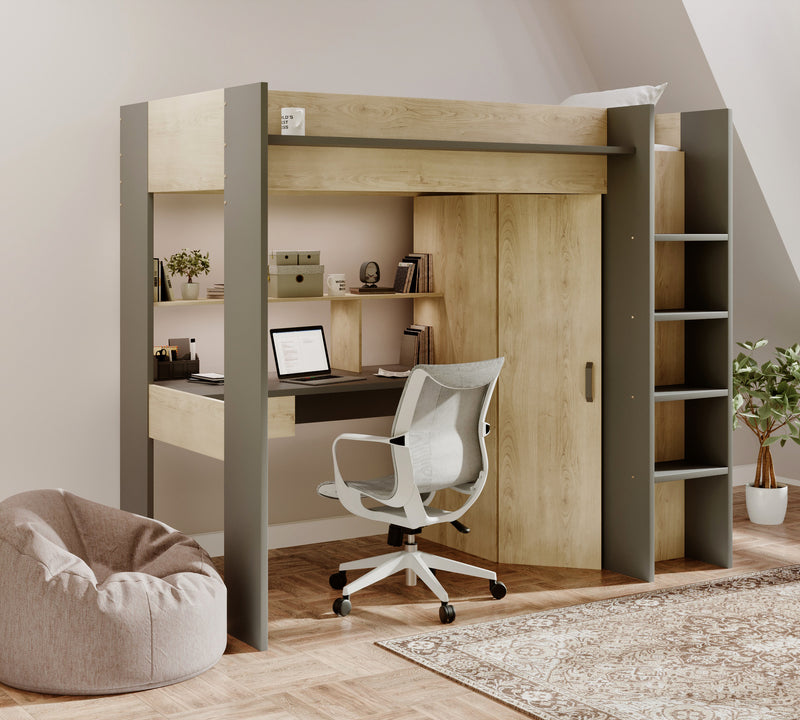
Replaces a whole piece of furniture
A wardrobe
A full-height wardrobe underneath removes the need for a separate one, which in a box room is often the piece of furniture there's simply no space for.
The Kensington, Arlo and Highgate all pair a wardrobe with a desk, and the Mini Highsleeper does the same at a lower height. See all beds with wardrobes.
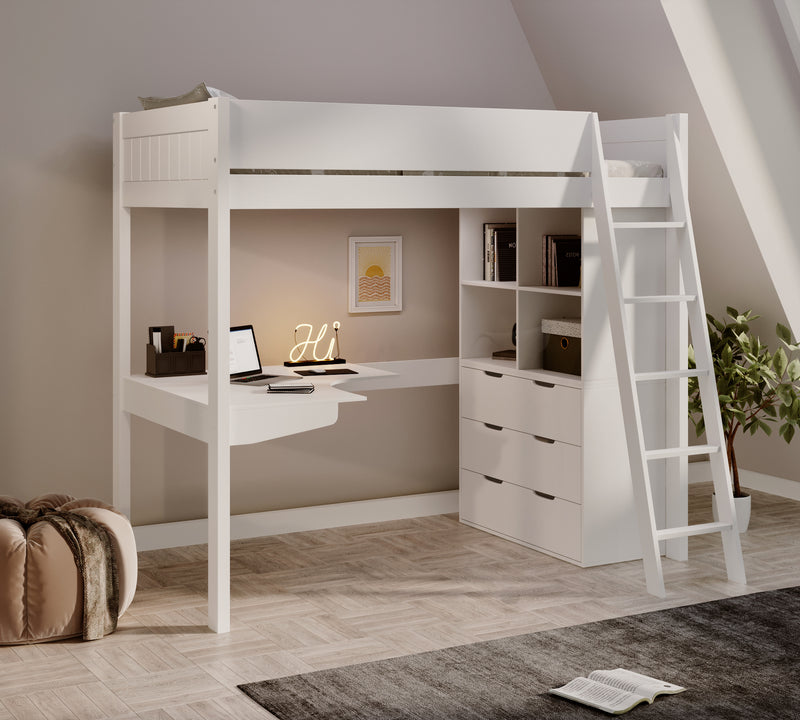
For homework
A desk
Check the desk length rather than assuming. A desk of around 150cm takes a laptop, a monitor and an open textbook at once; a short one takes a laptop and not much else. The Cambridge has a long corner desk with drawers and cubes, and the Freya adds shelves and drawers.
Our guide to high sleeper desk sizes explains what fits, or see all beds with desks.
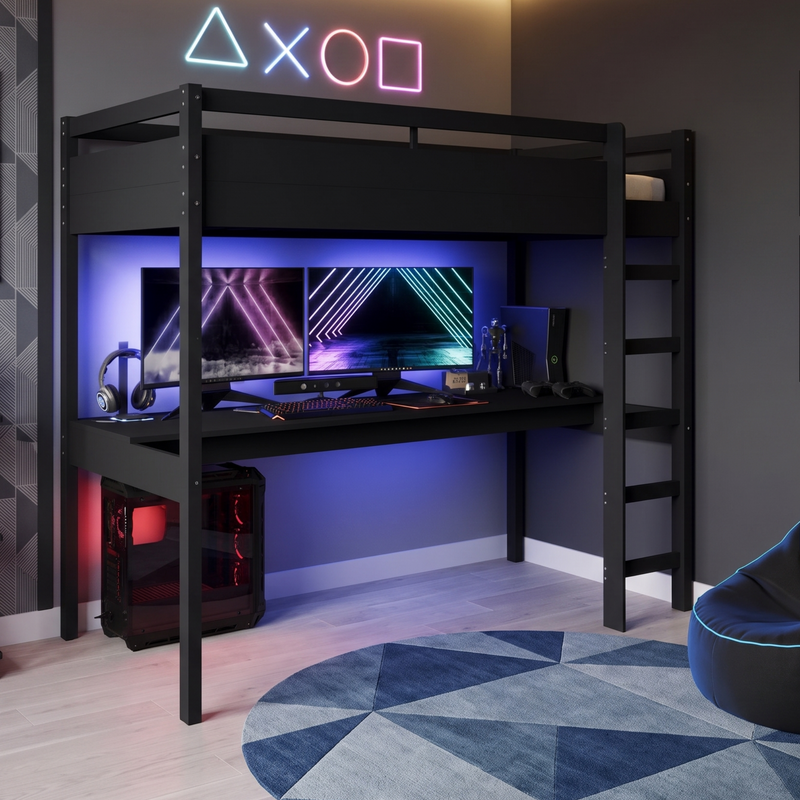
Screens and a PC
A gaming setup
Two things to check that a homework desk doesn't need: desk depth, because a monitor needs more room than a laptop, and clearance above the desk, because the underside of the bed can sit lower than you'd expect.
The Jax has a full-width 198cm desk and is also our most affordable high sleeper, and the Alderley adds a sofa bed and wardrobe. See all gaming beds.
If a ladder is the worry
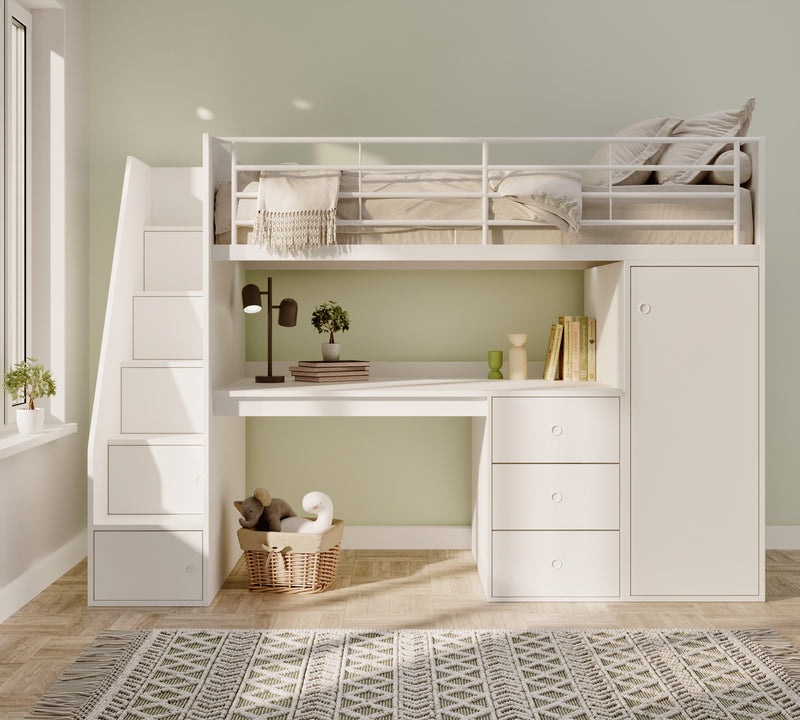
Stairs with storage
A staircase gives proper steps, which are easier to climb than rungs, and the steps double as drawers. The Marlow adds a desk and a wardrobe too. Check whether the stairs fit on either side before ordering, as some are fixed.
Two children, one room
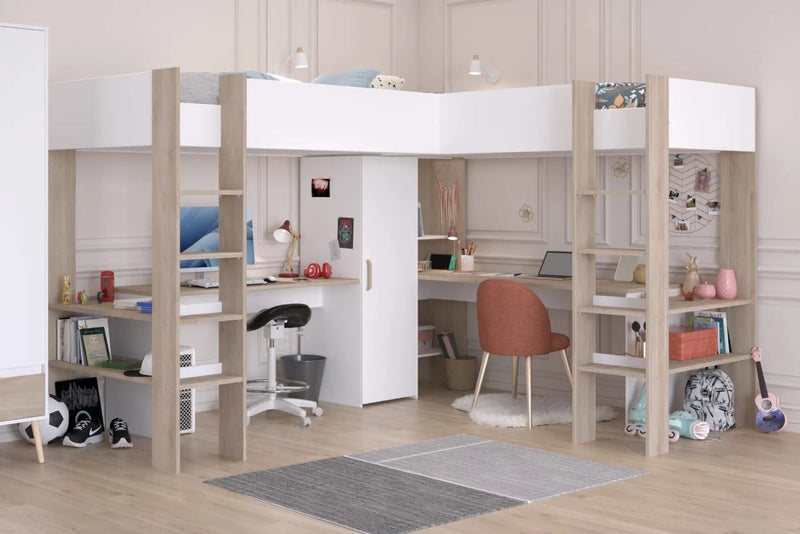
An L-shaped pair
The Alexandra sets two raised beds at right angles, each with its own desk, plus a wardrobe, so two children each get a sleeping and study space in one room. It takes two continental single mattresses.
For two children sleeping one above the other instead, see our bunk beds.
For a simpler, lower-cost option with a desk and shelves, see the Pure loft bed. Our guide to the types of high sleeper compares every layout side by side.
When a high sleeper isn't the answer
Worth being straight about, because this is where regret happens.
- Your child is under 6. No version of a high sleeper works. A low cabin bed or storage bed does.
- There isn't enough headroom, or the ceiling slopes above where the bed would go.
- Your child sleepwalks, or has difficulties with balance or coordination.
- You'll be changing the sheets. Making a bed at head height is genuinely awkward, and it's the thing parents most often tell us they hadn't thought about.
- The room is already big enough. If floor space isn't the problem, you're adding height for nothing.
If any of those apply, look at a single bed with storage instead. It's less dramatic, and it lasts longer. Our guide to how much storage beds hold compares the options.
Practical things to check
- Where the ladder goes. On some beds it adds to the length, on others the width, and it isn't always in the headline dimensions. Make sure it won't block a door or radiator.
- Clearance under the platform. If a desk goes underneath, make sure there's room to sit up straight at it.
- Access. High sleepers arrive flat-packed in several long boxes, so think about tight turns on the stairs.
- Assembly. Allow two adults and a few hours. Assembly is available on many of our beds; see beds with assembly.
- Bedding. A fitted sheet is far easier than a duvet cover at that height, and some families use a zip-up duvet for exactly this reason.
Safety in use
- Guard rails fitted on all exposed sides, and the ladder secure.
- The bed fixed to the wall where the manufacturer's instructions say so.
- A mattress within the stated maximum depth.
- Nothing hung from the frame: no ropes, bags, belts or fairy lights.
- The ladder kept clear, with nothing climbable placed beside it.
- Fixings re-tightened every few months, and after moving the bed or any heavy use.
There's more on our safety advice page.
Common questions
What age is a high sleeper suitable for?
Six and over, in line with BS EN 747. That applies to the sleeping platform however high the frame is.
How much ceiling height do I need?
Measure from the top of the mattress to the ceiling, directly above where the bed will stand. A younger child needs roughly 70cm to sit up comfortably, and a teenager 80 to 90cm. If that's tight, a lower design like the Mini Highsleeper may fit.
What's the difference between a high sleeper and a mid sleeper?
Height. A high sleeper leaves room for a desk, wardrobe or sofa bed underneath. A mid sleeper is lower, with room for drawers, shelves or a pull-out desk. Both are for children aged 6 and over.
What mattress does a high sleeper need?
Usually a standard UK single, 90 x 190cm, though some take a continental single, 90 x 200cm. Either way, it must be no deeper than the bed's stated maximum, typically 15 or 16cm.
Are high sleepers safe?
Yes, when used as intended. BS EN 747 sets the safety requirements for high sleepers, and the product page shows where a bed meets it. What matters day to day is the age rule, the right mattress depth, guard rails on all exposed sides, wall fixing where required, and regularly checked fixings.
Can two children share a high sleeper?
Not one platform, no. For two children in one room, look at bunk beds or an L-shaped pair like the Alexandra.
Is it hard to change the bedding?
It's the most common complaint we hear. Fitted sheets are far easier than duvet covers at that height, so it's worth planning for.
Get the floor back
High sleepers with sofa beds, wardrobes, desks and gaming setups underneath.
Shop high sleepersStill deciding on the type of bed? Read our kids' bed buying guide.


