





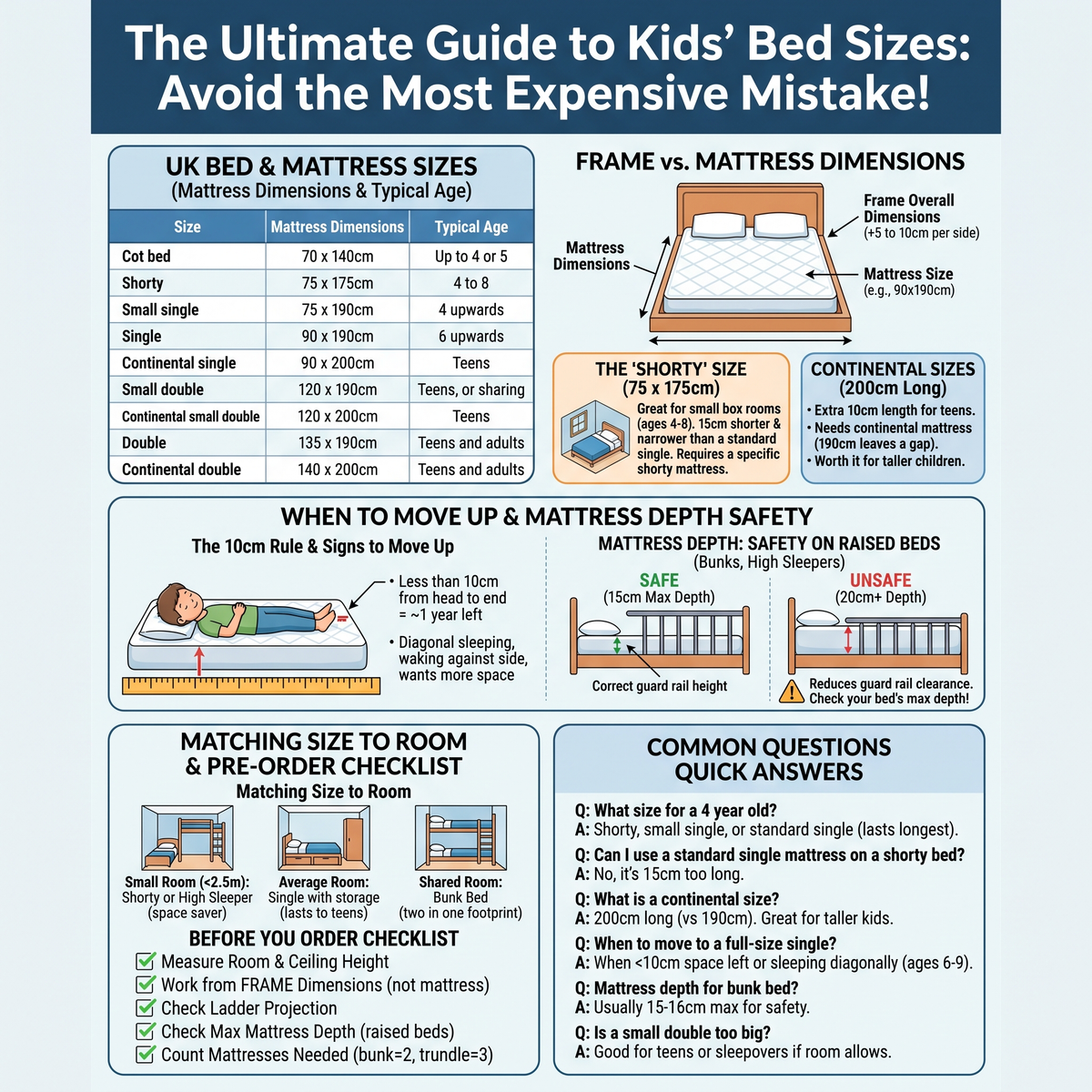
Getting the size wrong is the most expensive mistake in buying a child's bed, because you usually don't find out until it's built. In the UK, bed sizes for kids start at cot beds measuring 70 x 140cm and go up to continental doubles at 140 x 200cm, with options such as shorty beds at 75 x 175cm for smaller rooms and children aged roughly 4 to 8.
For parents of young children and teenagers trying to match a bed to both age and bedroom space, this guide covers every size we sell, when to move up, the mattress depth and room-fit checks that catch people out, and the practical differences between styles such as bunk, trundle and standard beds so you can buy a bed that is comfortable, safe and worth keeping as your child grows.
UK bed and mattress sizes
|
Size |
Mattress dimensions |
Typical age |
|---|---|---|
|
Cot bed |
70 x 140cm |
Up to 4 or 5 |
|
Shorty |
75 x 175cm |
4 to 8 |
|
Small single |
75 x 190cm |
4 upwards |
|
Single |
90 x 190cm |
6 upwards |
|
Continental single |
90 x 200cm |
Teens |
|
Small double |
120 x 190cm |
Teens, or sharing |
|
Continental small double |
120 x 200cm |
Teens |
|
Double |
135 x 190cm |
Teens and adults |
|
Continental double |
140 x 200cm |
Teens and adults |
The bed frame itself is larger than the mattress, usually by 5 to 10cm on each side. Always work from the frame's overall dimensions when you're measuring a room, not the mattress size.
The size most people don't know exists
Shorty, 75 x 175cm. It's 15cm shorter and 15cm narrower than a standard single, which sounds trivial and isn't. In a small box room it's often the difference between the bed fitting and not.
It suits roughly ages 4 to 8, so it buys three or four years. The trade-off is that it's an extra size along the way, so if the room allows it, going straight from a cot bed to a standard single saves a purchase.
The thing to watch: a shorty bed needs a shorty mattress. A standard single won't fit, and it's an easy and expensive mistake. We stock shorty mattresses in the correct size, which many retailers don't.
Continental sizes explained
Continental sizes are 200cm long rather than 190cm. That extra 10cm matters more than it sounds once a child hits their teens, and it costs nothing extra in floor space that a growing teenager won't use.
The catch is that a continental bed needs a continental mattress. A standard 190cm mattress leaves a 10cm gap at the end, which is both uncomfortable and, on a raised bed, an entrapment risk.
If you're buying for a child who's already tall for their age, it's worth going continental now rather than replacing at fourteen; a 90x200 cm single gives that extra length for the same reason Twin XL-style longer singles appeal to taller children or teenagers who may outgrow a standard twin.
When to move up a size
Forget age brackets. Use the bed itself.
Toddler beds are generally designed for children aged 1 to 5 years, but moving up should still depend on fit and sleep habits. Cot beds are designed for babies transitioning to toddler beds.
The 10cm rule. Measure from the top of your child's head to the end of the mattress while they're lying flat. Once there's less than 10cm, you've got roughly a year left.
Other signs:
-
They sleep diagonally, or with feet hanging over
-
They wake up against the side of the bed regularly
-
They've stopped wanting to be in it, which is often about space rather than the bed
Children grow in bursts rather than steadily, so a bed that fitted at the start of the school year often doesn't by the summer, especially as your choice should reflect your child's height as well as growth spurts. Some children take around 3 days to settle into a new bed, and the 3-3-3 approach is a simple rule of thumb for that adjustment period.
Mattress depth: the one that catches people out
Size isn't the only measurement that matters. On any raised bed, choosing the right mattress depth matters just as much as the right size for safety.
Bunk beds, high sleepers and mid sleepers have a maximum mattress depth, usually 15 or 16cm. Guard rails are designed to sit a set height above the mattress surface. Most high-street single mattresses are 20cm or deeper, which removes 5cm of guard rail and stops it doing its job. On bunk beds especially, younger children often benefit from a more supportive, firmer feel, so a firm mattress that stays low-profile can suit growing bodies better.
Trundle beds have their own limit, usually around 10cm, because the mattress has to clear the frame above when it slides away.
Everything in our bunk bed mattress range is built at 15cm for this reason. Check the maximum depth on your bed's product page before ordering the right mattress, as that same depth guidance also helps protect your child's sleep and comfort.
Matching size to room
Small rooms, under about 2.5 x 2.5m
A shorty or small single can free up meaningful floor space in a child's bedroom, and an extendable bed can work well here too because it starts compact and later grows from 140 cm to 200 cm, creating more space and enough room for play in smaller bedrooms.
If ceiling height allows and your child is 6 or over, a high sleeper is the bigger gain, because the bed goes up and the floor comes back; loft beds can maximise space by creating extra space underneath for a study area.
Under 6, a mid sleeper or cabin bed does the same job at a safer height, and mid sleepers can add extra storage underneath in a child's room.
Measure room size and room layout first so the bed fits the available space and still leaves extra room for storage and movement, with a compact option giving more room to move around.
Average rooms
A standard single is often the most useful, durable single bed you can buy for a growing child, and beds with built in storage are a practical way to maximise space in average-size rooms while lasting from six through to the teens.
These space saving beds also suit growing families because they add storage without taking up more floor area.
Shared rooms and children's beds
A bunk bed sleeps two in the footprint of one, saving floor space by stacking sleeping areas. The top bunk is typically for children aged 6 and over, while a younger child should use the bottom bunk. If the ceiling is low or the younger child is under 6, look at low bunks specifically. Triple bunk beds can also work when three children share one room, provided the room and ceiling height allow it. Our guide to low bunk beds covers the differences.
Sleepovers
A trundle bed looks like a single and pulls out into two, which makes it useful for sleepovers or family visits because it adds a second sleeping space without taking up extra room day to day. This is ideal when you need an extra bed but still want to maximise space in the room.
Before you order a bed frame
-
Measure room dimensions, including ceiling height directly above where the bed will stand, and make sure there's still room for play and storage.
-
Work from the frame dimensions, not the mattress size. The frame is bigger, so check the [available space] around it, not just whether the mattress fits.
-
Check the ladder projection on any bunk or raised bed. It isn't always in the headline dimensions.
-
Check the maximum mattress depth if it's a raised bed.
-
Count the mattresses. A bunk needs two. A bunk with a trundle needs three.
Not sure? Message us with the room dimensions and your child's age and we'll tell you what fits.
Common questions
**What size bed does a 4 year old need?**A shorty, small single or standard single all work, and these are among the most common kids bed sizes for this age. If your child is child ready for the move, a toddler bed usually suits ages 1 to 5 and often sits lower to the ground at around 33cm high to help keep things child secure. A standard single lasts longest; a shorty fits a small room better.
**What's the difference between a shorty and a small single?**Length. A shorty is 175cm, a small single is 190cm. Both are 75cm wide. If you want a step between a larger bed for little ones and a standard single, a junior bed is usually 80 x 160cm and suits the right age group.
**Can I put a standard single mattress on a shorty bed?**No, it's 15cm too long. Shorty beds need shorty mattresses at 75 x 175cm. If you're moving on from an adjustable crib, cot beds are often the next step and can sometimes reuse the same cot mattress size if the product is designed for it.
**What is a continental size?**200cm long instead of 190cm. Common on European-made beds and worth having for a taller child or teenager before moving to an adult bed. It needs a continental mattress to match.
**When should my child move to a full-size single?**When there's less than 10cm between their head and the end of the mattress, or when they start sleeping diagonally. Usually somewhere between six and nine. Many toddler beds include removable rails, which can make the transition feel easier before you pick the perfect bed from the wider range of kids beds.
**What mattress depth do I need for a bunk bed?**Check your specific bed, but it's usually a 15 or 16cm maximum. Deeper reduces the guard rail clearance. For children's beds, check they meet EN 716 where applicable.
**Is a small double too big for a child?**Not if the room takes it. At 120 x 190cm it's a good option for a teenager, or for a child who'll have friends staying.
Still deciding what type of bed rather than what size? Read our kids' bed buying guide.


