A bunk bed sleeps two children in the floor space of one, and bunk beds with storage fit the chest of drawers in too. In a shared bedroom, nothing else comes close, and with a pull-out trundle underneath, it sleeps three.
As a UK kids' bed specialist, we've spent years helping families find bunk beds that work in compact British homes. A typical child's bedroom in a UK semi is around 8 to 10 square metres, and that has to take sleep, storage, play and, increasingly, homework. Stacking the beds and building the storage into the frame is often the only way that room becomes genuinely usable.
Our range runs from slim metal frames through to full setups with a built-in wardrobe, drawers and shelving. BS EN 747 is the British standard for bunk beds, covering guard rails, entrapment gaps, ladder stability and load testing. Where a manufacturer has confirmed a bed's certification, it's stated on the product page.
Bunk Beds with Storage
Bunk beds are space-saving beds stacked vertically, and for many families they're the simplest way to fit two sleeping spaces into one room without losing the floor. They're especially useful for parents of young children or teenagers in UK homes where bedrooms are small or shared, and storage matters just as much as sleep space.
Bunk beds with storage are the most popular kind we sell, and the reason is simple: a shared bedroom rarely has wall space for two beds plus a wardrobe and a chest of drawers. Building the storage into the bed means one piece of furniture instead of three.
A bunk bed with drawers or shelves frees up roughly 1 to 2 square metres compared with two separate singles plus a chest of drawers. In a 2.1 x 3 metre box room, that's the difference between cramped and comfortable, and it usually means the centre of the floor stays clear for a play mat or a small desk.
From there, the right choice comes down to layout, age and safety: storage options, stairs versus ladders, bed sizes, wood or metal frames, mattress depth, BS EN 747 standards, and the practical details of choosing, assembling and maintaining a bunk bed that will still work as children grow.
Under-Bed Drawers
Many of our wooden bunks include one or two full-length drawers on runners or castors beneath the lower bunk, typically 95 to 100cm wide and 15 to 20cm deep inside. That's enough for pyjamas, spare duvet covers, out-of-season clothes and the larger soft toys that otherwise colonise the floor.
In rooms where there genuinely isn't space for a separate chest of drawers, which is most UK box rooms, under-bed storage stops being optional.
End Shelves and Headboard Storage
Open shelving built into the bed ends or headboard solves the bedtime problem every child has: where do I put my book, my water, my torch? It also removes the need for a bedside table, which narrow rooms rarely have room for.
Worth not overloading them. A few books, a small light and one or two personal things keeps the sleep space calm and stops items falling during the night.
Staircase Drawers and Cupboards
Staircase bunks use each step as storage, typically four to six deep drawers or lift-up compartments. The depth surprises people: a step drawer holds considerably more than a flat under-bed drawer, which makes them worth the higher price if you're dealing with Lego, board games or sports kit rather than clothes.
Some models also hide a slim cupboard beside the stairs, giving hanging space without a full wardrobe. Particularly useful in loft conversions, where sloped ceilings limit where a wardrobe can go.
Wardrobe and All-in-One Units
For maximum function from minimum floor area, some bunks incorporate a narrow wardrobe alongside drawers and shelving, making them a smart all-in-one choice for a child's bedroom. These replace a wardrobe, a chest of drawers and a bookcase in one footprint.
Trundle Drawers and Pull-Out Guest Beds
Worth knowing the difference between a deep storage drawer and a trundle. A trundle looks similar but is built to take a slim mattress, turning a two-sleeper bunk into a three-sleeper when needed, for guests or sleepovers. When it isn't in use as a bed, it holds spare bedding, so it never sits empty.
Always check the maximum mattress depth for a trundle, usually around 10cm, so it clears the frame above and slides fully away.
Our Bunk Beds with Storage
All our bunk beds have their mattress requirements listed on the product page, and some can be paired with mattresses for the top and bottom bunks when you order.
Bunk Beds with Stairs
A staircase instead of a ladder. Wider treads, enclosed sides and a handrail make climbing to the top bunk considerably easier, and the steps usually hold drawers, so the storage comes free.
The trade-off is footprint: a staircase adds meaningfully to the bed's length or width, so measure before choosing one over a ladder. The Easy Staircase Bunk Bed with Pull-Out Trundle combines stairs with a third bed underneath.
See all bunk beds with stairs.
Double and Small Double Bunk Beds
Also sold as triple sleepers. A small double (120 x 190cm) or double (135 x 190cm) on the bottom with a standard single on top, which sleeps three: two on the lower bunk and one above.
These work well for a bigger age gap, since a parent can sit or lie on the bottom bunk at bedtime rather than perching on the floor. They also suit older children who've outgrown a standard single, and families who host visiting grandchildren at weekends.
You'll need two different mattress sizes: a small double or double for the bottom, depending on the bed, and a standard single for the top.
Wooden Bunk Beds
Solid pine and wood-finish frames make up most of our range, and for good reason. Wood is warmer to look at than metal, takes a painted finish that can be touched up years later, and gives a wooden bed frame the strength to carry integrated drawers, which is why most of our bunk beds with storage are wood.
Our most popular finishes are white, Cashmere (a soft grey-beige) and natural pine. Those colours suit more than one style of room and still look right when the child is a teenager, which is the point: a pirate ship theme feels exciting at five and dated at ten. Put the personality into bedding and wall art, which cost a fraction to change.
More on materials in solid pine vs MDF.
Metal Bunk Beds
Slimmer in profile than wood and generally less expensive, which makes them a sensible choice for a very compact room or a tighter budget. Less suited to heavy integrated storage, since wood joinery carries drawer weight better.
Detachable Bunk Beds
Split bunk beds come apart into two separate single beds. Worth having if there's any chance the children will want their own rooms, and detachable models suit changing needs as children grow, or the younger one wanting the top bunk when they turn six.
It's the single feature that most extends the useful life of a bunk bed, and it usually costs nothing extra at the point of purchase. Buy one and you'll typically keep the bed eight to ten years, adjusting the configuration as needs change.
See all detachable bunk beds.
Bunk Beds with a Trundle
A third mattress on a low rolling frame that slides away under the bottom bunk. It sleeps three without taking any more floor space, and it's what most families choose once sleepovers start.
Ideal for cousins staying in the school holidays, or a shared room where a third child occasionally needs a bed. The trundle takes a shallower mattress, usually around 10cm, so it clears the frame above.
See all bunk beds with a trundle.
Bunk Beds with Slides
For a bunk that doubles as a climbing adventure and adds more fun to bedtime, the Treehouse Bunk Bed with Platform and Slide sleeps two, with a slide that goes on whichever side your room allows. One child on the slide at a time, feet first, and the top bunk is still for children aged 6 and over. See all our kids beds with slides.
Low and Shorty Bunk Beds
Two different things, and worth knowing which you need.
Low bunk beds have lower overall heights, which helps in a room with a low or sloped ceiling and keeps the contrast clear with shorty bunks. Shorty bunks are shorter, taking a 175cm mattress rather than the usual 190cm, which takes 15cm off the length of the whole bed. In a small box room, that's often the difference between fitting and not.
A shorty bunk needs shorty mattresses at 75 x 175cm. A standard single won't fit, and it's an easy mistake to make.
More in our guide to why more parents are choosing low bunk beds.
Triple and Quadruple Bunk Beds
For three or four children in one room. Ceiling height becomes the limiting factor rather than floor space, so measure directly above where the bed will stand.
See all triple sleepers and quadruple bunks.
Bunk Beds or Loft Beds?
If only one child needs a bed, a loft bed, which we call a high sleeper, is often the better use of the same footprint. The space underneath becomes a desk, a wardrobe or a sofa bed rather than a second bed. For two or more children sharing one room, a bunk bed is the only way to fit everyone in without losing the floor. Our guide to loft beds vs bunk beds goes through the choice in detail.
Bunk Bed Sizes
Most bunk beds take two standard UK single mattresses at 90 x 190cm, one on each tier. The variations worth knowing:
Shorty bunk beds use mattresses sized 75 x 175cm, making them suitable for small rooms where space is limited. Some compact bunk bed frames accommodate small single mattresses measuring 75 x 190cm. The most common bunk beds fit a standard single mattress of 90 x 190cm. For taller children, some European-style bunk beds use continental single mattresses sized 90 x 200cm. Triple sleeper bunk beds often feature a small double mattress on the bottom bunk, measuring 120 x 190cm, providing extra sleeping space. Some triple sleepers may use a double mattress sized 135 x 190cm on the bottom bunk, offering even more room for older children or teenagers.
Bunk bed frames typically run 196 to 200cm long, with widths from around 100cm for a single-over-single up to around 160cm for a triple sleeper. Work from the frame dimensions when you're measuring a room, not the mattress size, since the frame is always larger.
The mattress size each bed requires is stated on every product page. More detail in our kids' bed size guide.
Kids Bunk Beds for Toddlers and Younger Children
The top bunk of any bunk bed is for children aged 6 and over. That's the guidance under BS EN 747, and we apply it however low the frame is. It reflects the coordination and night-time awareness needed to climb safely and sleep at height.
The bottom bunk has no equivalent restriction, which is why a bunk bed works well for mixed-age siblings: the older child goes on top, the younger one underneath. It's the most common arrangement we sell into.
Even if a younger child seems confident climbing during the day, night-time disorientation and the unfamiliar feeling of height are what cause falls. Age guidance for each bed is stated on its product page. Toddlers using the lower bunk should still be supervised, especially while they're getting used to the bed.
For a toddler needing their own bed sooner, see our toddler beds and beds for children aged 3 and over.
Bunk Beds for Teenagers
Requirements change at this age. A small double bottom bunk gives noticeably more room than a 90cm single, and a continental single at 200cm suits a teenager who's still growing, since it adds 10cm of length and no extra width.
Weight limits matter more too, and they differ between the two tiers. Where a manufacturer publishes a figure, it's stated on the product page.
If only one teenager needs a bed and the room is tight, a high sleeper is usually the better use of the same footprint, since the space underneath becomes a desk or wardrobe rather than a second bed. See all our beds for teenagers.
Don't Forget the Mattresses
The most commonly forgotten part of a bunk bed order, and the one that ruins a delivery day, is ordering the right number of mattresses.
- Standard bunk: two mattresses
- Bunk with a trundle: three, and the trundle one is shallower
- Triple sleeper: a small double or double, and a single
- Quadruple: four
Depth is a safety figure on the top bunk, usually a maximum of 15 or 16cm. Guard rails are designed to sit a set height above the mattress surface, and most high-street singles are 20cm or deeper, which reduces that clearance. On the upper bunk, the right depth keeps the guard rails effective. Re-check it whenever you replace a mattress.
Most of our bunk bed mattresses are built at 15cm for exactly this reason, in every size from shorty to double: the PocketRest 15cm, MemoryDream 15cm and ComfortSleep 15cm, with the TrundleEase 10 for trundles. There's more detail in our bunk bed mattress guide.
Safety
Storage features have to be designed so they don't become climbing hazards or compromise guard rail height, and well-designed storage bunks account for that. What matters at home:
- Guard rails on all sides of the top bunk, fitted and secure, with no wobble, to help prevent falls
- Mattress within the stated maximum depth on the top bunk
- No gap between the bunk and the wall that a child could slip into
- Nothing hung from the frame: no ropes, bags, skipping ropes or fairy lights
- One person on the ladder or staircase at a time, and one person on the top bunk
- No jumping on either bunk, and no playing on the ladder
- Fixings re-tightened every few months, and after any move or reconfiguration
Leave enough clearance between the top mattress and the ceiling for an older child to sit up comfortably. Most UK homes are fine, but check in loft conversions and rooms with sloped ceilings.
Storage safety: keep heavier items in lower drawers, make sure drawers close fully and don't stick out into walking paths, and check drawer runners periodically for smooth operation.
Full detail on our bed safety page.
Choosing the Right Bunk Bed
Measure the Room First
You need length, width and ceiling height, plus the position of doors, radiators, windows and anything built in, especially in small bedrooms.
- Ceiling height, measured directly above where the bed will stand rather than at the highest point of the room
- Clearance for drawers to open fully, usually 40 to 60cm in front of the bed. A drawer you can't open is storage you can't use
- Where the ladder or staircase will sit, so it doesn't block a door, a wardrobe or access to a window
- Access, since bunk beds arrive flat-packed in several long boxes, and getting them into a child's room up the stairs and round a tight turn is worth thinking about
A rough floor plan on paper saves a lot of trouble later.
Match the Storage to the Clutter
Think about what's currently on the floor (toys, books and other belongings), then pick storage that targets it and helps save space:
- Soft toys and teddies → deep under-bed drawers
- Books and bedtime things → end shelves and headboard storage
- Lego, board games, sports kit → staircase step drawers
- Clothes and bedding → under-bed drawers, or a wardrobe unit
Younger children generate more toy clutter, so drawers and cubbies work best. Older children need shelving for books and tech, and the right layout is especially useful for siblings sharing.
Choose a Bed That Lasts
- Detachable bunk bed frames that convert into two singles
- Standard UK mattress sizes, so replacements are easy to find
- Neutral finishes in white, grey, Cashmere or oak, for a look that still works from childhood into the teen years
- Solid or engineered wood for bunk beds with storage, where the drawers add weight
Looking After It
- Monthly: visual check of guard rails and ladder
- Every three months: tighten all accessible bolts and screws, focusing on the ladder, staircase and guard rails
- Every six months: full inspection, including drawer runners and slat positioning
- After replacing a mattress: confirm the depth is within the stated limit
Painted and lacquered frames wipe down with a soft damp cloth and mild soap. Avoid abrasive cleaners. Felt pads or fabric baskets inside drawers protect the bases from sharp toy corners, and scuffs on white or grey paint touch up easily with a colour-matched paint pen.
Children climbing daily will gradually loosen fixings, so catching that early stops wobbles turning into anything worse.
Assembly and Delivery
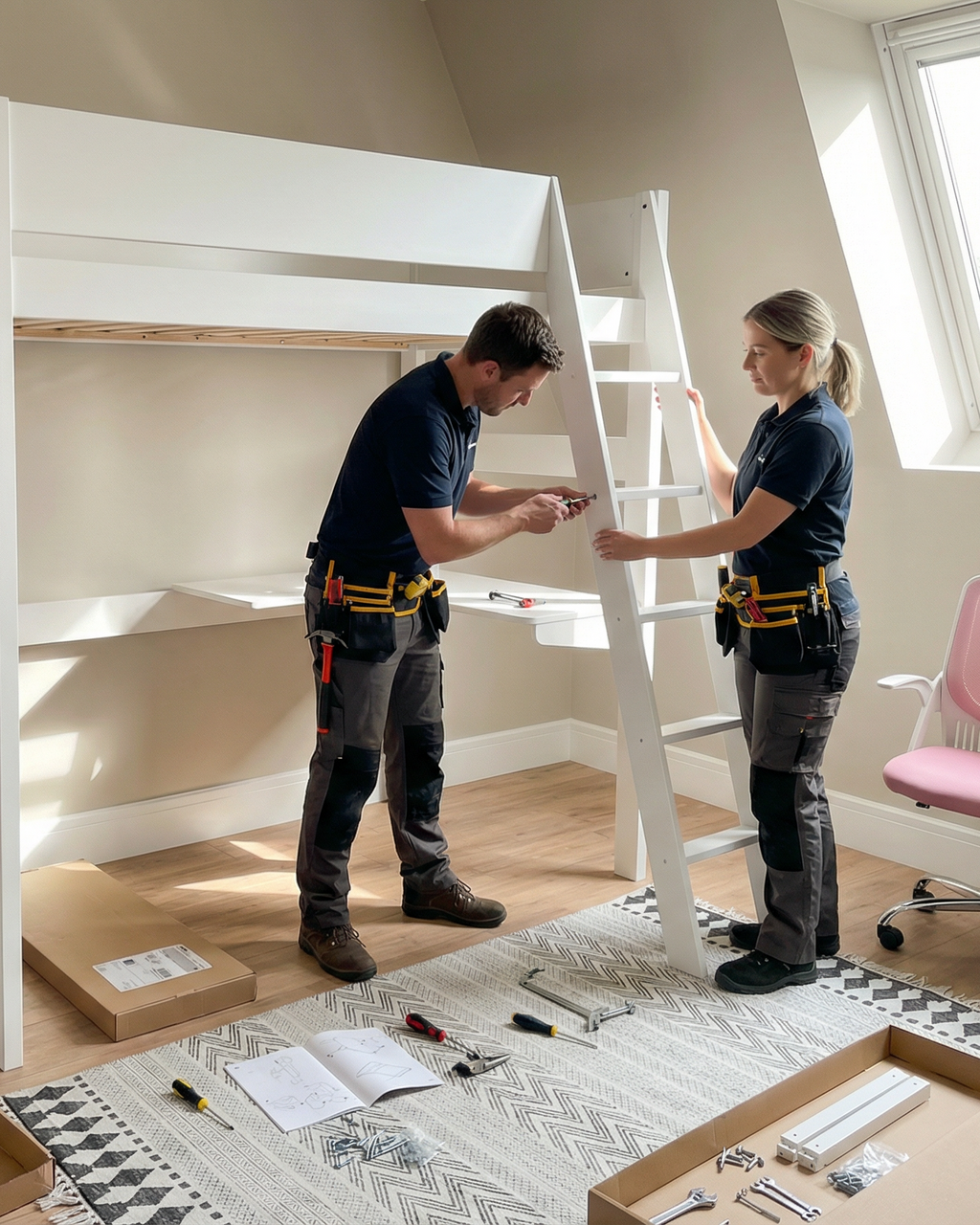
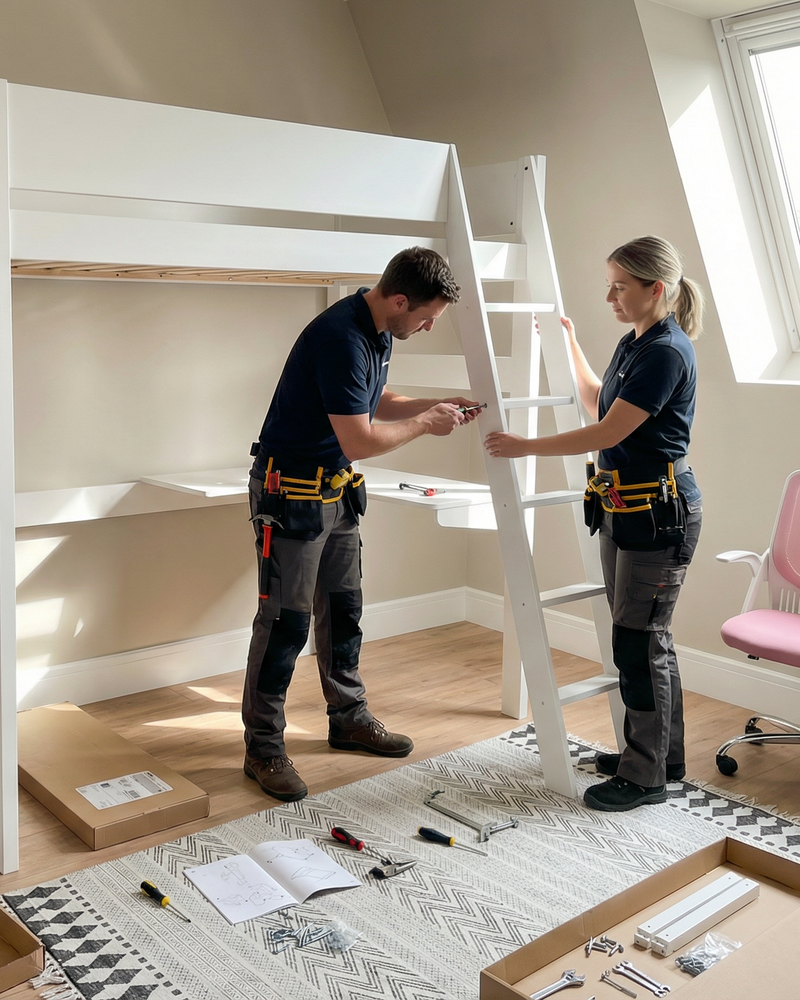
Bunk beds arrive flat-packed, which makes getting the boxes upstairs considerably easier. Allow two adults and one and a half to three hours.
Unpack everything and check against the inventory list before starting, lay the parts out in the room the bed will stay in, build the main frame before adding guard rails and the ladder, and have one person support the structure while the other tightens fixings.
If you'd rather not, our room-of-choice assembly service builds the bed where you want it and takes the packaging away. Many bunk beds are available for next day delivery, and you can spread the cost at checkout. More on our delivery information page.
Bunk Beds: Common Questions
What age can a child sleep on the top bunk?
Six and over, under BS EN 747. There's no equivalent restriction on the bottom bunk, which is why a bunk bed works well for mixed-age siblings, giving each child their own sleeping zone in one room.
Are bunk beds with storage worth it?
In a shared bedroom, almost always. Drawers or a wardrobe built into the frame replace the separate furniture there usually isn't room for, help save space, and free up 1 to 2 square metres of floor.
How many mattresses does a bunk bed need?
Two. Three if it has a trundle, and the trundle mattress is shallower at around 10cm.
What mattress depth for a bunk bed?
Usually a maximum of 15 or 16cm on the top bunk, so the guard rails stay effective. The exact figure is on each product page.
What size mattress does a bunk bed take?
Most take two standard UK singles at 90 x 190cm. Shorty bunks take 75 x 175cm, and triple sleepers take a small double (120 x 190cm) or double (135 x 190cm) on the bottom.
Do bunk beds split into two single beds?
Some do. Look for "detachable" in the title or description. It's the feature that most extends the life of the bed.
What is a double bunk bed?
Usually a bunk with a small double (120 x 190cm) or double (135 x 190cm) on the bottom and a standard single on top. Also called a triple sleeper, since it sleeps three. L-shaped designs place the lower bed at a right angle to the top bunk.
What's the difference between a low bunk and a shorty bunk?
Low and shorty bunks come in different overall heights: a low bunk is lower overall, for a low or sloped ceiling. A shorty is shorter, taking a 175cm mattress instead of 190cm, for a small room.
Are wooden bunk beds better than metal?
Wood is warmer in appearance, takes a repairable painted finish, and carries integrated drawer weight better. Metal frames are slimmer, generally cheaper, and suit a very compact room or an older child.
Ladder or stairs?
Stairs are easier and safer to climb and usually have drawers built into the steps, but they add to the bed's footprint. A ladder takes almost no space and costs less.
Can an adult sleep on a bunk bed?
On the bottom bunk of most models, yes. On the top bunk, only if the product page says so.
How much ceiling height do I need?
Enough for the child on top to sit up comfortably with clear space above their head. Measure directly above the bed's position and check against the bed's overall height.
Are bunk beds safe?
Yes, when used as intended. What matters is the age rule for the top bunk, the correct mattress depth, and fixings checked regularly; guard rails help prevent falls from the upper bunk. If you're comparing them with loft beds, the same basic checks apply.
Is the top bunk hotter than the bottom?
Yes, because heat rises. A lower tog duvet on the top bunk is the simplest fix. More in our guide to room temperature and children's sleep.
Not sure which is right? Read our bunk bed buying guide, try our bed finder quiz, or message us with your room dimensions and your children's ages, and we'll tell you what fits.