





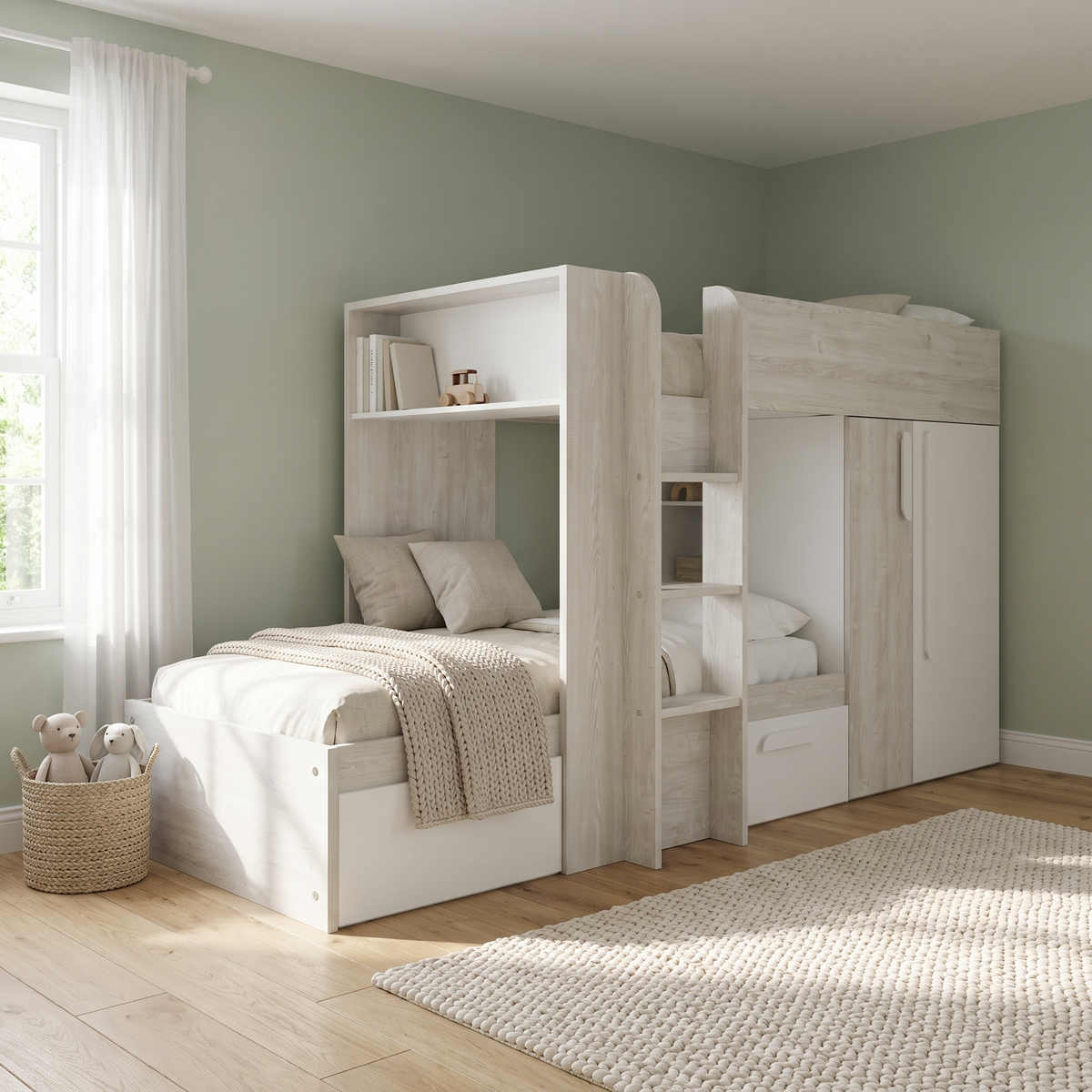
A bunk bed sleeps two children in the floor space of one. In a shared room that's the whole point, and nothing else comes close.
But there are more decisions here than in any other bed category, and one rule that isn't negotiable. This covers both.
The rule: the top bunk is 6 and over
Children under 6 must not use the top bunk. This is set by BS EN 747, the British standard for bunk beds and high beds, and it applies to every bunk bed regardless of how low the frame is.
It exists because spatial awareness, coordination and the ability to respond safely when disorientated at night all develop significantly between four and seven.
The bottom bunk is a different matter. There's no equivalent restriction, which means a bunk bed works perfectly well for mixed-age siblings: the older child goes on top, the younger one underneath. That's the most common arrangement we sell into.
When the younger one turns six and wants to swap, a detachable bunk gives you options. More on that below.
The two measurements and weight limit
Ceiling height. The child on the top bunk needs to sit up comfortably with clear space above their head. Measure directly above where the bed will stand, not the highest point of the room. Sloped ceilings and loft conversions are where this catches people out.
Mattress depth. Choosing the right mattress for the top bed usually means a 15 or 16cm maximum on the top bunk. Guard rails are designed to sit a set height above the mattress surface, and most high-street singles are 20cm or deeper, which reduces the effective height of the guardrails by 5cm.
Our bunk bed mattresses are built at 15cm for exactly this reason.
Which type of bunk?
Standard bunk
Two singles stacked. The simplest and usually the cheapest way to sleep two.
-
HoppeKids Shorty Bunk Bed, from £359.00
-
Nyla Cashmere Low Bunk Bed, £379.99
Detachable bunk — the one that lasts longest
Splits into two separate single beds. Worth paying for if there's any chance the children will want their own rooms, or if the younger one will want the top bunk when they turn six.
It's the single feature that most extends the useful life of a bunk bed, and it costs little or nothing extra at the point of purchase.
-
Ashby Detachable Bunk Beds with Trundle, from £519.99
Bunk with a trundle — sleeps three
A third mattress on a low rolling frame that slides away underneath. It's how you sleep three in the footprint of one bed, and it's the version most families choose once sleepovers start.
The trundle usually takes a shallower mattress, around 10cm, so it clears the frame above when it slides back.
-
Burford Storage Bunk Bed with Pull-Out Trundle, From £569.99
Bunk with storage
Drawers, shelves or a wardrobe built into the frame make this a space saving option for a shared bedroom. A children's bunk bed can be a fantastic space saving solution when floor area is tight. One piece of furniture instead of three, which matters more in a shared room than anywhere else.
-
HoppeKids Shorty Bunk Bed with Drawers, from £475.00
Family bunk — a double underneath
A small double on the bottom and a single on top. Good for a parent reading at bedtime, for two younger children sharing the bottom, or for guests.
Triple and quadruple
For three or four children in one room. Worth measuring carefully, since ceiling height becomes the limiting factor rather than floor space.
-
The King Quadruple Bunk, £399.99
Low bunks
Lower overall height, which helps with low or sloped ceilings. The 6+ rule for the top bunk still applies.
Covered in more detail in our guide to low bunk beds.
Ladder or staircase?
A ladder takes up almost no space and costs less, but a stable ladder is the safer standard. A staircase is easier and safer to climb, and the steps usually have drawers built in, so the storage comes free.
The trade-off is footprint. A staircase adds meaningfully to the bed's length or width, so measure before committing to one; these are practical safety features as well as space decisions.
Two things to check on any bunk: which side the ladder attaches, and whether it's reversible. Some are fixed, and finding out after assembly is an expensive lesson. The ladder should be securely attached and checked regularly for safety.
You'll need two mattresses. Or three.
The most commonly forgotten part of buying a bunk bed, and the one that ruins a delivery day, is buying the right mattress or more, depending on type.
-
Standard bunk: two mattresses, both within the stated maximum depth
-
Bunk with trundle: three, and the trundle one is usually shallower, around 10cm
-
Shorty bunk: two shorty mattresses at 75 x 175cm, not standard singles
-
Family bunk: a small double and a single, plus a trundle mattress if fitted
Check the top bunk’s weight limit or weight capacity before allowing use, as these can vary depending on the maker and model.
Order them at the same time as the bed. See our bunk bed mattress range, or the bed size guide for the right dimensions.
When a bunk bed isn't the answer
-
Low or sloped ceiling. Look at low bunks, or two separate beds.
-
Both children under 6. The bottom bunk is fine, but you're buying a two-tier bed and only using one tier; a toddler bed may be more suitable before moving your little one into a bunk setup.
-
Sleepwalking, or difficulties with balance.
-
You'll be changing the sheets. Making the top bunk is awkward, and it's the most common thing parents say they hadn't considered.
-
A big age gap. A teenager and a toddler sharing a bunk rarely works for long, and it can add extra safety risks in the same sleeping setup.
Bunk bed safety in use
For simple bunk bed safety, use this checklist as part of your normal safety guidelines:
-
guardrails on all sides of the top bunk, fitted and secure, are essential safety features for the upper bunk
-
Mattress within the stated maximum depth on the top bunk
-
No gap between the bunk and the wall that a child could slip into
-
Nothing hung from the frame: no ropes, bags, skipping ropes or fairy lights
-
One person on the top bunk at a time to reduce the risk of falls
-
Check screws and bolts for tightness every few months, and after any move or reconfiguration
-
If a detachable bunk is put back together as a bunk, re-run the full check and confirm all guard rails are refitted
Falls are the most common cause of bunk-bed injuries, so children should be taught to bunk safely and follow safety rules.
Full detail on our bed safety guidance page.
Before you order
-
Measure ceiling height directly above where the bed will stand.
-
Measure the floor space, including the ladder or staircase projection.
-
Check whether it detaches, if there's any chance you'll want two separate beds later.
-
Check the maximum mattress depth for the top bed and use the right mattress.
-
Check the bed’s sturdy construction, including whether it is sturdy and durable enough for the intended users; solid wood is one common option.
-
Confirm the weight capacity before use, especially for the upper bunk.
-
Count the mattresses. Two, or three with a trundle.
-
Plan the assembly. Two adults, one and a half to three hours. We offer room-of-choice assembly if you'd rather not.
Common questions
What age can a child sleep on the top bunk?The minimum age is 6 years old, set by BS EN 747. There's no equivalent restriction on the bottom bunk.
Can a 4 year old have a bunk bed?On the bottom bunk, yes, and that's often suitable from 2 to 3 years old. Not on the top, which isn't the right age until later. A bunk bed works well for mixed-age siblings for exactly this reason.
Are bunk beds safe?Yes, bunk beds safe use comes down to the right age and the proper safety features.
How much ceiling height do I need for a bunk bed?Enough for the child on top to sit up comfortably with clear space above their head. Measure directly above the bed's position and check against the bed's overall height.
What mattress depth for a bunk bed?Usually a 15 or 16cm maximum on the top bunk. Check the specific figure on the product page. The bottom bunk can often take a deeper one.
Does a night light help?A night light can help a younger child on the bottom bunk move around more safely at night.
Do bunk beds split into two singles?Some do, some don't. It's listed on each product page as detachable. If it matters, check before ordering, since it isn't a modification to make yourself.
What's a trundle?A third mattress on a low rolling frame that slides away under the bottom bunk. It's how a bunk bed sleeps three without taking more floor space.
Ladder or stairs?Stairs are easier to climb and usually have storage built in, but they add to the bed's footprint. A ladder takes almost no space and costs less, and whichever you choose, children still need to follow safety rules.
Is the top bunk hotter?Yes, usually by two to three degrees, because heat rises. A lower tog duvet on the top bunk is the simplest fix. More in our guide to room temperature and children's sleep.
Are bunk beds fun for kids?Many children find them fun and use them for imaginative play, but the top bunk still has age limits.
What should I check before buying kids bunk beds?Start with the maker's age recommendations and check the weight limit.
Still deciding what type of bed? Read our kids' bed buying guide, or browse all bunk beds.


