





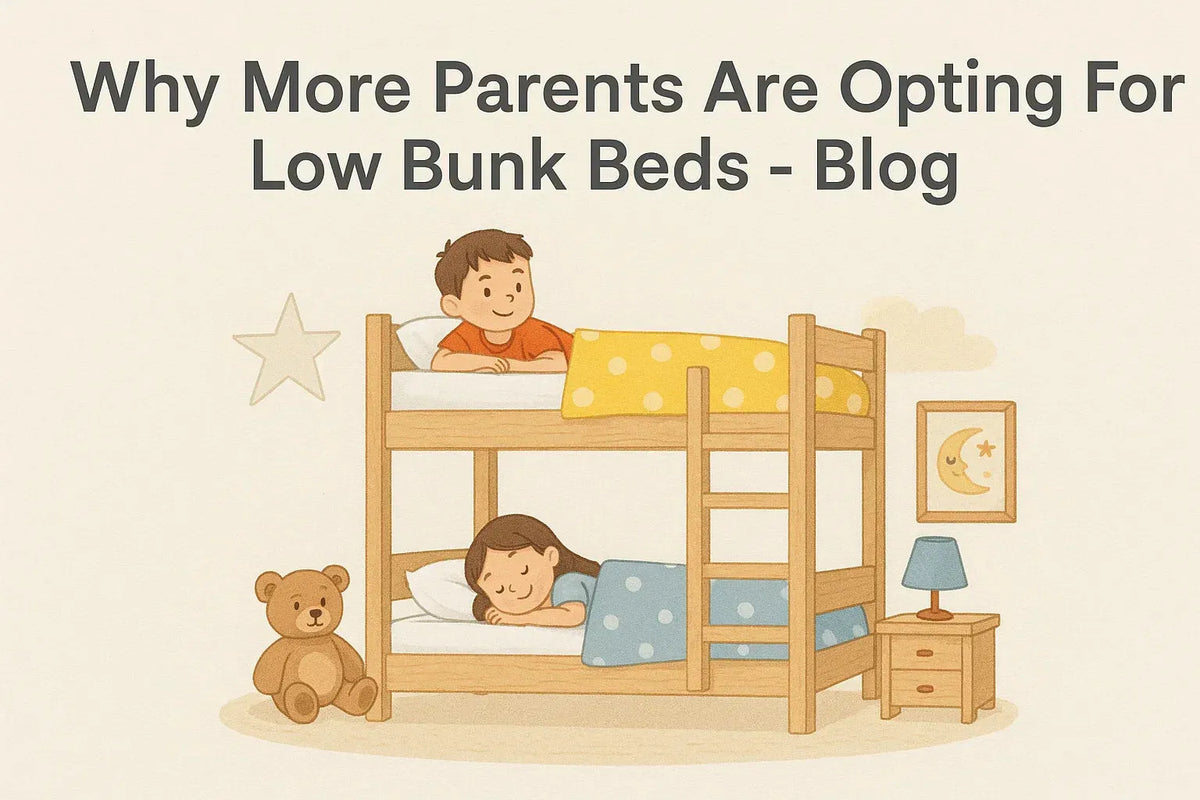
A low bunk bed brings the top bunk much closer to the floor. The age rule for the top bunk doesn't change, but almost everything else about the bed does.
A standard bunk bed puts the top mattress around 130 to 150cm off the floor. A low bunk brings that down to roughly 80 to 110cm, which changes three things at once: the height of any fall, whether the bed fits under a sloped ceiling, and how far there is to climb at bedtime.
That's why more parents are choosing low bunk beds for a shared bedroom, and why they're among the most useful bunk beds for kids in smaller UK homes.
What Is a Low Bunk Beds?
A low bunk bed is a bunk bed with a shorter frame, so both the top bunk sleeping area and the overall height sit lower than on a standard bunk bed. The Nyla Cashmere Low Bunk Bed, for example, is 112cm tall overall, where many standard bunk bed frames stand 150cm or more.
It still gives two children their own sleeping space in the floor space of one single bed, with a top bunk (the upper bunk) and a bottom bunk (the lower bunk), guard rails on the top bunk and a ladder to climb up. The difference is height: less to climb, less to fall, and much more headroom above.
For UK parents buying for children aged 6 to 16 in a small bedroom, a shared room, or a room with a low or sloped ceiling, that lower height can make planning the space much easier while keeping the room more open and comfortable. This guide explains how low bunk beds compare with standard bunks and shorty bunks, who they suit, the space-saving and safety points to check, how to measure ceiling height and room dimensions, what mattress depth you need, which product options are worth considering, and when another space-saving bed might be a better fit.
Low Bunk vs Standard Bunk Bed
|
|
Low bunk bed |
Standard bunk bed |
|---|---|---|
|
Top mattress height |
Roughly 80 to 110cm |
Roughly 130 to 150cm |
|
Overall height |
Often under 120cm |
Often 150cm or more |
|
Best for |
Low or sloped ceilings, younger siblings sharing |
Standard rooms, older children |
|
Top bunk age |
6 and over |
6 and over |
Low Bunk vs Shorty Bunk
Two different things, and worth knowing which you need. A low bunk is lower. A shorty bunk is shorter, taking a 175cm mattress rather than the usual 190cm, which takes 15cm off the length of the whole bed. Some beds are both. If your problem is ceiling height, you want a low bunk; if it's floor length, a shorty.
Low Bunk vs Mid Sleeper
A mid sleeper is a single raised bed with storage or play space underneath, rather than a second sleeping area. Both are space-saving choices for a child's bedroom. If only one child needs a bed, a mid sleeper gives you storage in a similar height; if two children share, a low bunk gives you two beds.
Who Low Bunk Beds Are Actually For
Rooms with low or sloped ceilings. The rule that matters is that a child should be able to sit up on the top bunk without their head near the ceiling. In a loft conversion or a room with coving, a standard bunk bed often fails that test and a low bunk doesn't.
Younger siblings sharing. The under-6 guidance for top bunks doesn't change with height, and we'd never suggest otherwise. But a low bunk means the younger child on the bottom bunk isn't sleeping in a cave, and the room feels open rather than dominated by furniture. It's one of the best bunk beds for kids with an age gap, with separate sleeping spaces for each child: the older child sleeps on top, the younger one underneath.
Kids who move a lot in their sleep. Guard rails work. But if you've got a restless sleeper, less height above the floor is genuinely reassuring, and it's the reason a lot of parents choose one.
Smaller bedrooms. A low bunk sleeps two kids in the footprint of one single bed, without the visual weight of a full-height bunk bed frame. In a 2.1m box room, that's the difference between a bedroom and a storage unit, and it leaves more floor space for play.
A growing family. If a new baby is on the way or a sibling is about to move out of a cot bed, a low bunk lets the older child move to the top bunk now, with the bottom bunk ready for later. It's a space-saving way to plan ahead without buying twice.
Why Low Bunk Beds are Space Saving in Smaller Bedrooms
Most UK children's bedrooms are small, and a shared room for multiple children has to fit beds, clothes, toys and somewhere to do homework. Kids bunk beds are the obvious space-saving answer, because stacking the beds frees the floor that a second single bed would take. A low bunk goes a step further in a smaller bedroom, because it doesn't dominate the room visually or crowd the ceiling.
A few ways a low bunk helps you save space:
-
Two sleeping spaces, one footprint. Two children sleep in the floor area of one single bed, which leaves more floor space for play.
-
Room above the top bunk. With less height, the space above the bed stays usable, and the room feels bigger.
-
Storage underneath. A low bunk with drawers creates additional storage space, one of the practical storage solutions that helps keep the room organised.
-
Clear sight lines. A lower frame keeps windows and light clear, which matters in a box room and helps the room feel like it still has ample space.
If the room is short on length rather than height, a shorty bunk saves another 15cm of space, and some kids bunk beds manage both.
The Safety Rules Don't Change
Worth being straight about this, because some retailers imply a low bunk is a way around the age guidance. It isn't.
-
The top bunk is still for children aged 6 and over. That's the guidance under BS EN 747-1:2024, the British standard for bunk beds, and it applies to low bunks just as much as full-height ones. Younger children can safely use the bottom bunk, which many parents find reassuring for extra peace.
-
Guard rails on all sides of the top bunk, fitted and secure. Rounded edges are also common on low bunk beds because they help reduce knocks in everyday use.
-
Mattress depth matters more on a low bunk, not less. Too deep and the guard rail loses its clearance. Check the maximum depth for your specific bed.
-
Nothing hung from the frame. No ropes, bags, skipping ropes or fairy lights.
-
One child on the ladder at a time, and no jumping from the top bunk, however low it is.
-
Re-tighten the fixings every few months, and after any heavy use.
More detail in our bed safety guidance.
Our Low Bunk Beds
Nyla Cashmere Low Bunk Bed
Our main low bunk, and the one we'd point most families at first, because it's an amazing bed for families who want a practical, long-lasting option. A solid pine wooden bunk bed in a warm Cashmere finish that sits between beige, taupe and soft grey, it uses durable, child safe materials so it works in a younger child's bedroom and still looks right when they're ten. If you prefer a lighter look, a crisp white finish can help brighten the room, but this softer tone is easier to live with day to day. It's one of the best children's bunk beds we sell for smaller rooms. At 112cm tall overall, it sits well under most sloped ceilings, with full-length guard rails on the top bunk and a fixed ladder. Good low bunk construction usually uses solid wood or robust engineered materials, and this model is made from solid pine wood.
It's a great bed for smaller rooms and one that can still suit them for years.
Both bunks take a standard UK single mattress at 90 x 190cm.
See the Nyla Cashmere Low Bunk Bed
HoppeKids Shorty Bunk Bed with Drawers
The one to look at if your room is genuinely tight on length. A shorty bunk takes a 175cm mattress, which takes 15cm off the length of the whole bed, and this one adds storage drawers underneath for clothes and storing toys, making the room easier to keep tidy. If the bunk is replacing a bed and a chest of drawers, this is the version that does both jobs and saves space on the floor.
Solid pine with a smooth lacquered finish, in crisp white or natural, with an optional safety rail.
See the HoppeKids Shorty Bunk Bed with Drawers
Or browse our full range of kids bunk beds and shorty beds.
Choosing the Right Low Bunk Bed Frame
Wood or metal? Most low bunk beds are wooden, and a wooden bunk bed in solid pine is the one we'd usually suggest. Solid pine is strong, carries the weight of drawers well, and a painted or lacquered finish can be looked after for years. A contemporary bunk bed can still be practical if the design keeps safety features and storage in mind. Metal bunk bed frames are slimmer and often cheaper, but they're rarer in low designs and less suited to built-in storage.
Ladder position and easy access. Check where the ladder sits and how it's fitted. A sturdy ladder, fixed to the bed frame rather than hooked on, gives children easy access to the upper bunk and doesn't move when they climb. Make sure it won't block a door, a wardrobe or a window once the bed is in place.
Storage. If the bunk is replacing a chest of drawers too, choose one with drawers underneath for extra storage. It keeps toys and clothes off the floor and makes a shared bedroom far easier to keep tidy.
Detachable or fixed? Detachable children's bunk beds split into two single bunk beds, which is worth having if the children may want their own rooms later. It's the feature that most extends the life of a bunk bed, and it's listed on each product page.
Style. A calm finish, like Cashmere, white or natural pine, suits a child's bedroom at five and still works at twelve. Put the personality into bedding and wall art, which are easy to change as they grow.
Low Bunk Beds for Kids of Different Ages
Toddlers and under-6s. The lower bunk is fine for a toddler or young child, and a low bunk means they're not sleeping underneath a towering frame. The top bunk isn't for them yet, however confident they seem, and a young child on the bottom bunk should still be supervised while they get used to it.
Ages 6 to 11. The sweet spot for low bunk beds for kids. Old enough for the top bunk, still small enough that the lower frame gives them plenty of headroom, and young enough to enjoy the bunk as a den and a reading spot.
Older kids and teenagers. A low bunk still works for older kids, but a tall child on the top bunk will have less room to sit up. For a teenager, check the height between the top mattress and the ceiling, and consider a standard bunk or a high sleeper instead.
Whatever their age, sleeping on the top bunk should feel safe and settled, and kids sleep better in a bed they like. If a child is nervous about the height, a low bunk is often the bed that gets them there.
Other Ways to Fit Two Children into a Small Room
If a low bunk doesn't suit your room, these are the other kids bunk beds and space-saving beds we'd look at to save space:
-
A bed with a pull-out trundle. A single bed with a pull out trundle underneath: a second bed on castors, pulled out for sleepovers or a sibling. It also works well as a guest bed between sleepovers or family visits. Ideal for hosting sleepovers and cousins in the school holidays. See our beds with a trundle and guest beds.
-
A bunk bed with a trundle. A full-height bunk that sleeps three, for when two isn't enough. See our bunk beds with a trundle.
-
A double bunk bed. A small double or double bed on the bottom with a single on top, also called a triple sleeper. A double bunk bed is usually full height, so it needs a standard ceiling. See our triple sleepers.
-
Detachable bunk beds. Children's bunk beds that split into two single bunk beds later, when the children want their own rooms. See our detachable bunk beds.
Mattresses: The Bit People Get Wrong
Two things catch people out on any bunk bed, low or otherwise.
Depth. Most high-street single mattresses are 20cm or deeper. On a bunk, that eats into the guard rail clearance, and the rail stops doing its job. Our bunk bed mattresses are built at 15cm for exactly this reason, including the PocketRest 15cm, MemoryDream 15cm and ComfortSleep 15cm.
Size, if you're buying a shorty. A shorty bunk needs a 75 x 175cm mattress, not a standard single. It's an easy mistake to make and an expensive one, so check before you order. We stock shorty mattresses in the right size.
And you'll need two. It sounds obvious, but it's the single most common thing people forget at checkout. More in our bunk bed mattress guide.
Measuring Up
Three measurements before you order anything:
Ceiling height above where the bed will go. Not the highest point of the room, the point directly above the bed. Allow enough for a child to sit up comfortably on the top bunk.
Floor space, including the ladder. The ladder projection isn't always in the headline dimensions, so check the full spec on the product page.
Door and stair access. Bunk beds arrive flat-packed in several boxes, and they're long boxes, even for a low bunk. Worth a thought if you've got a tight turn on the stairs.
Our kids' bed size guide has every mattress and frame size side by side. If you're not sure, message us. We'd rather spend five minutes checking than have you sent the wrong bed.
Making the Most of a Low Bunk
A low bunk leaves more space above and around the bed than a standard bunk, which makes it easier to turn into a proper child's room rather than just a place to sleep.
Make the bottom bunk a reading nook for the kids. Cushions along the back, a few favourite books within reach and a reading light that clips to the wall, not the frame, and the bottom bunk becomes a sofa by day.
Keep storage low and close. Storage space underneath the lower bunk, or a shorty bunk with built-in storage, keeps toys and clothes off the floor. Wall shelves beside the bed give the top bunk somewhere to put a book and a water bottle.
Let the bedding do the decorating. A calm frame with clean lines, like the Nyla, works with any bedroom decor and keeps the sleeping area calm. Change the bedding and wall art as they grow, which costs a fraction of changing the bed.
Leave the frame bare. Fairy lights and bunting look lovely, but nothing should hang from a bunk bed frame. Put them on the wall instead.
Low Bunk Bed Checklist
Before you buy one of our kids bunk beds, run through this quick checklist. It's the most space-saving way to avoid a bed that doesn't fit.
-
Ceiling height: enough space above the top bunk for your child to sit up comfortably.
-
Floor space: the full footprint including the ladder, plus space to stand and make the beds.
-
Sleeping arrangements: the older child, aged 6 or over, sleeping on the top bunk, and the younger one on the lower bunk.
-
Mattresses: two of them, the right size, and no deeper than the bed's maximum.
-
Ladder: a sturdy ladder fixed to the frame, on the side that suits the room.
-
Storage space: drawers underneath if the bunk is replacing a chest of drawers in the child's bedroom.
-
Future plans: whether you'll want single bunk beds that split later, or a double bunk bed as the children grow.
-
Delivery and assembly: flat packed boxes up the stairs, and time set aside for home assembly.
Assembly and Care
Low bunks arrive flat-packed for home assembly, like most kids bunk beds. Allow two adults and a couple of hours, build the bed in the room it will stay in, and have one person support the frame while the other tightens the fixings. If you'd rather skip the home assembly, our room-of-choice assembly service is available on selected beds, including the Nyla.
Check the guard rails and ladder monthly, re-tighten the bolts every three months, and re-check after moving the bed. Children climbing daily gradually loosen fixings, so catching that early keeps the bed solid for years.
Common Questions
What age can a child use a low bunk bed?
The bottom bunk, or lower bunk, suits most ages. The top bunk is for children aged 6 and over, and that applies to low bunks the same as any other. It's the guidance under BS EN 747, and it's based on coordination and night-time awareness rather than height alone.
How low is a low bunk bed?
Typically, the top mattress sits around 80 to 110cm from the floor, against 130 to 150cm on a standard bunk. The Nyla is 112cm tall overall. Check the specific dimensions on each product page, since it varies by model.
Are low bunk beds safe?
Yes, when used as intended: children aged 6 and over sleeping on the top bunk, guard rails fitted and secure, a mattress within the maximum depth, and fixings checked regularly. Less height is reassuring, but it doesn't replace any of those rules.
Will a low bunk fit under a sloped ceiling?
Often yes, where a standard bunk won't. Measure the height directly above where the bed will stand, and make sure a child can sit up on the top bunk without their head near the slope.
What's the difference between a low bunk and a shorty bunk?
A low bunk is lower. A shorty is shorter, taking a 175cm mattress rather than 190cm. Some beds are both. If your problem is ceiling height, you want a low bunk; if it's floor length, a shorty.
Can a low bunk be split into two beds?
Some can, some can't. It's listed on each product page. If it matters to you, check before ordering, since it's not a modification we'd recommend making yourself.
Do low bunk beds come with storage?
Some do. The HoppeKids Shorty Bunk Bed with Drawers has storage drawers underneath, which gives you extra storage without a separate chest of drawers.
Can grown-ups sit on the bottom bunk?
On a low bunk, there's usually enough headroom for a parent to sit on the bottom bunk for a bedtime story, which is harder on some full-height bunks. Check any weight limit on the product page.
Are low bunk beds good for small rooms?
Yes. A low bunk sleeps two children in the footprint of one single bed, and the lower height keeps smaller bedrooms feeling open. For a room that's short on length too, look at a shorty bunk.
What's the best low bunk bed for kids?
For most families, the best bunk beds for kids in a low-ceilinged room are solid pine low bunks with full-length guard rails and a fixed ladder, like the Nyla. If you need storage or a shorter bed, a shorty bunk with drawers does both jobs.
What mattress do I need?
Two, both 15cm deep or less. A standard single at 90 x 190cm for most low bunks, or 75 x 175cm for a shorty.
Is a low bunk good for an older child or a growing family?
It works well while they're growing, and for a growing family it's an easy way to plan ahead, but a tall teenager on the top bunk will have less room to sit up on a low frame. For older children, a standard bunk or a high sleeper may suit better.
Not sure which of our kids bunk beds is right? Read our bunk bed buying guide, or browse all our kids bunk beds.


