


Three questions decide which bed is right for your child, and none of them is about style. Answer them and the shortlist is usually two or three beds. Everything else is preference.
1
How big is the room, and how high is the ceiling?
2
How old is your child, and are they 6 yet?
3
Does anyone else need to sleep in there?
On this page
Start with the room
Measure before you look at anything. Two numbers matter.
- Floor space. A standard single bed is 90 x 190cm, and you need room to walk round it and make it. In a typical UK box room, a bed plus a wardrobe and a chest of drawers leaves almost no floor at all.
- Ceiling height. This decides whether a raised bed is possible at all. Your child needs to sit up on the bed without their head near the ceiling. Measure from where the top of the mattress will be up to the ceiling: a younger child needs roughly 70cm, a teenager 80 to 90cm. Sloping ceilings often rule raised beds out.
If floor space is the problem, go up. If ceiling height is the problem, stay low and use storage instead.
The age rule that governs everything
The top bunk of a bunk bed, and the sleeping platform of a high sleeper or mid sleeper, are for children aged 6 and over.
That's the guidance in BS EN 747, the British standard for bunk beds and raised beds, and it isn't one to work around. It exists because coordination and night-time awareness develop a great deal between the ages of four and seven.
Under 6, that leaves floor-level beds, low cabin beds, toddler beds and the bottom bunk of a bunk bed, which is plenty. See our beds for ages 3 and up and beds for ages 6 and up.
The right bed for your situation
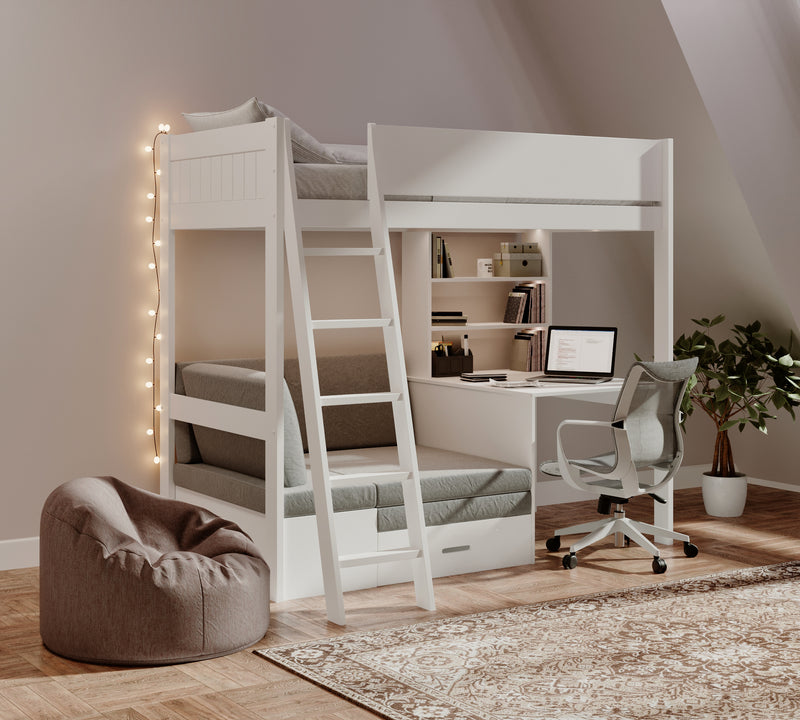
One child, a small room, aged 6 or over
A high sleeper
The single biggest space gain available. The bed goes up, and you get a desk, a wardrobe or a sofa bed underneath, in the footprint of one bed. Our best sellers are the ones with a sofa bed underneath, like the Windsor, because they solve two problems at once: the room works during the day, and a friend can stay over.
Browse high sleeper beds or read our high sleeper guide.
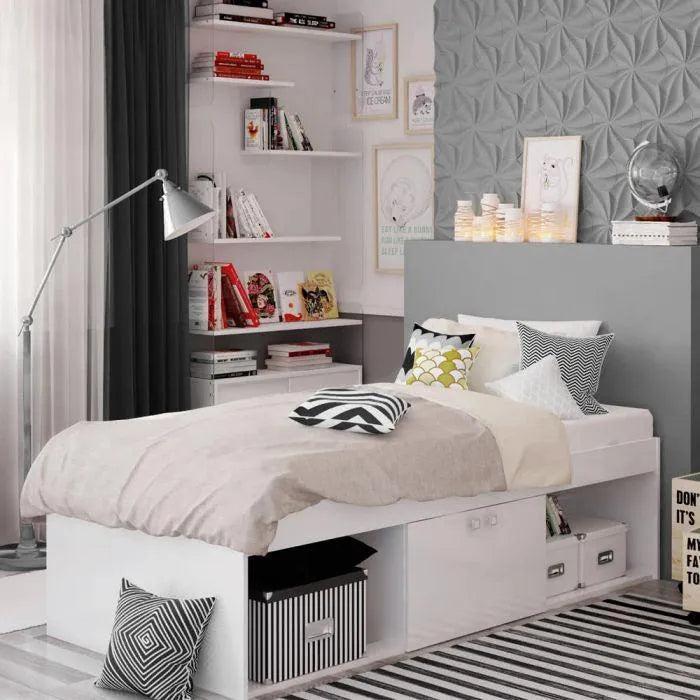
One child, a small room, under 6
A low cabin bed or storage bed
Storage built into the frame with no climbing: drawers, cupboards or shelves at close to normal bed height. The Voyager has shelves and a cupboard, and the Pioneer adds four drawers. When they turn 6, a mid sleeper or high sleeper becomes an option.
Browse cabin beds or read our guide to what a cabin bed is.
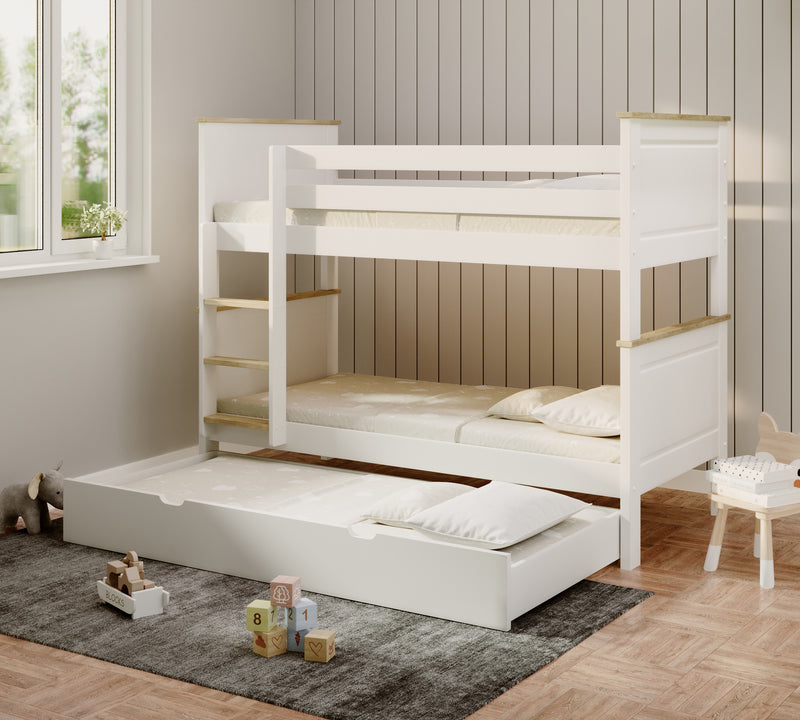
Two children sharing
A bunk bed
Which bunk depends on the ceiling, the younger child's age, and whether anyone else stays. A standard bunk suits two children aged 6 and over with a normal ceiling. A low bunk, like the Nyla, suits a lower or sloping ceiling; see our guide to low bunk beds. A bunk with a trundle, like the Ashby, handles a third child or regular sleepovers, and a double bunk sleeps three with a double on the bottom.
Whichever you choose, the top bunk is for 6 and over, and a younger child sleeps on the bottom. Browse bunk beds or read our bunk bed buying guide.
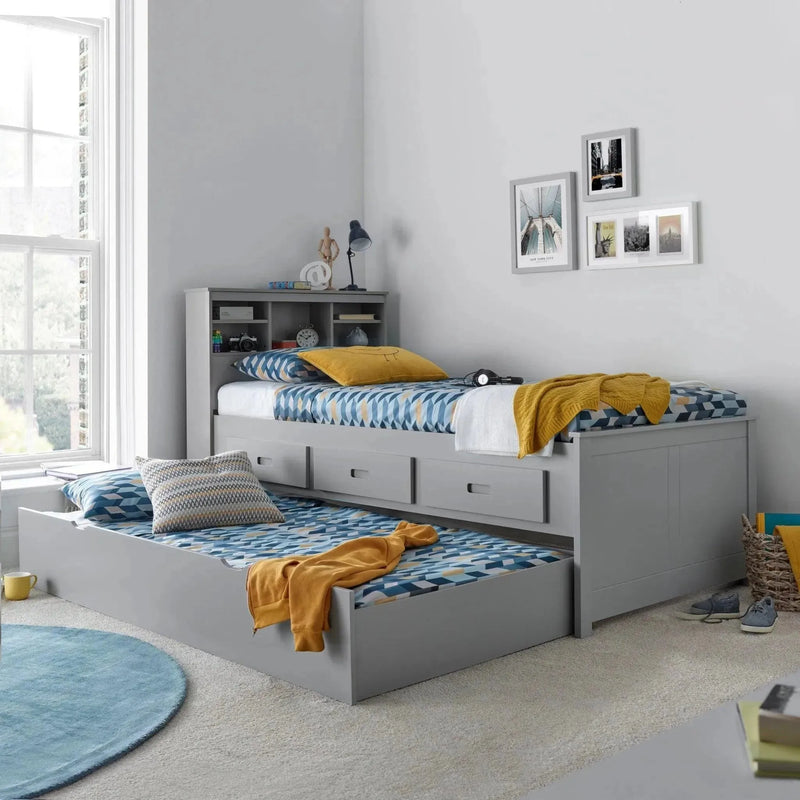
One child, but friends stay over
A guest bed with a trundle
It looks like a single bed and pulls out into two, so it takes up one bed's worth of floor the rest of the time. The Sienna is our best seller. Browse beds with trundles.
Moving out of a cot
A toddler bed, or straight to a single
A toddler bed is low to the floor with side rails and usually takes a 70 x 140cm cot bed mattress. Many children move out of a cot around the age of 2 or 3, often once they start climbing out. Plenty of families skip the toddler bed and go straight to a single with a bed guard, which saves a purchase. Browse toddler beds.
Teenagers
Space to work, and room to grow
Desk space matters more than play space, and a continental single, 90 x 200cm, gives 10cm of extra length for a growing teenager. A high sleeper with a proper desk works well, and so does a standard bed with good storage. See our guide to teenage beds for small rooms and our beds for teenagers.
When not to buy a raised bed
Worth saying, because it's the mistake we'd rather you didn't make.
- Your child is under 6. No exceptions for the top bunk or a raised sleeping platform.
- There isn't enough headroom. If your child can't sit up comfortably on the mattress, or the ceiling slopes above where the bed would go.
- Your child sleepwalks, or has difficulties with coordination or balance.
- You'll be making the bed every day. Changing sheets on a top bunk is genuinely awkward, and it's the complaint we hear most from parents who didn't think about it beforehand.
- The room is already big enough. If floor space isn't the problem, a raised bed adds height and complication for nothing.
Bed sizes
| Size | Mattress | Who it suits |
|---|---|---|
| Cot bed or toddler bed | 70 x 140cm | Toddlers, up to about 4 or 5 |
| Shorty | 75 x 175cm | Smaller rooms and younger children |
| Small single | 75 x 190cm | Narrow rooms, from about 4 |
| Single | 90 x 190cm | Most children, from about 3 or 4 into the teens |
| Continental single | 90 x 200cm | Tall children and teenagers |
| Small double | 120 x 190cm | Teenagers, or a bigger bottom bunk |
There's more detail in our kids' bed size guide.
Don't forget the mattress
Depth. Bunk beds, high sleepers and mid sleepers have a maximum mattress depth, usually 15 or 16cm, because the guard rail height is measured from the top of the mattress. Most high-street mattresses are 20cm or deeper. Our bunk bed mattresses are made at 15cm for this reason.
Quantity. A bunk needs two mattresses, and one with a trundle needs three, with a slimmer trundle mattress of around 10cm.
Fit. Match the size to the bed exactly, so there are no gaps at the sides or ends. Our kids' mattress guide covers sizes, depths and firmness.
Before you order
- Measure the room, including the ceiling height directly above where the bed will go.
- Check the ladder. On some beds it adds to the length or width, and it isn't always in the headline dimensions.
- Check access. Beds arrive flat-packed in several long boxes, so think about tight turns on the stairs.
- Plan the assembly. Raised beds usually need two adults and a few hours. Assembly is available on many of our beds; see beds with assembly.
- Order the mattresses at the same time, checking each one matches the bed exactly.
- Involve your child. Let them choose between the suitable options. A bed they've had a say in makes bedtime easier.
If you're stuck between two options, message us. We'd rather spend five minutes helping you choose than have the wrong bed delivered.
Common questions
What age can a child have a bunk bed?
The bottom bunk suits most ages. The top bunk is for children aged 6 and over, in line with BS EN 747.
What's the difference between a high sleeper and a mid sleeper?
Height. A high sleeper is high enough for a desk, wardrobe or sofa bed underneath. A mid sleeper is lower, with room for drawers, shelves or a pull-out desk. Both are for children aged 6 and over.
Is a high sleeper worth it in a small room?
It's the biggest space gain available, as long as there's enough headroom and your child is 6 or over. You get the floor space back.
How much ceiling height do I need?
Measure from the top of the mattress to the ceiling. A younger child needs roughly 70cm to sit up comfortably, and a teenager 80 to 90cm. Measure directly above where the bed will stand.
Should I buy a bed that grows with my child?
Where you can. A detachable bunk splits into two singles, and a standard single with storage lasts from the early years into the teens. Both save a purchase later.
What mattress do I need?
Match the size to the bed exactly. On any raised bed, check the maximum depth first, usually 15 or 16cm.