





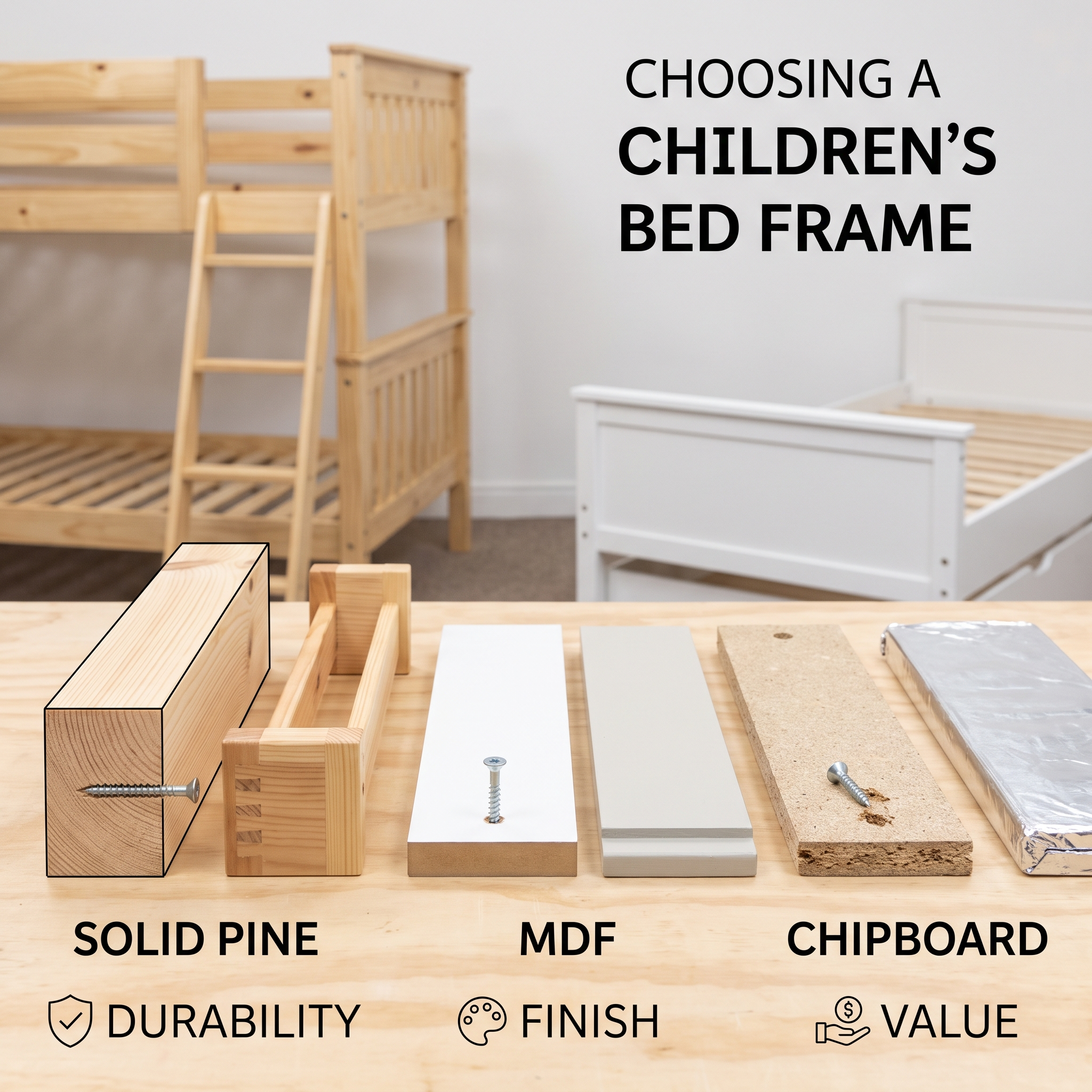
Solid Pine, MDF or Chipboard: Choosing a Children's Bed Frame
If you are comparing two children's beds that look almost identical but one costs £200 more, the difference is usually what the frame is made from.
This guide explains the difference between solid pine, MDF and chipboard in children's furniture, where the material genuinely matters, and where it honestly does not. We sell beds made from all of them, so this is not an argument that one is always right.
The short answer
Solid pine is worth paying for on raised beds, bunks, and any bed designed to be taken apart and rebuilt. That is because screws hold better in timber than in board, and those beds get dismantled when children change rooms or families move.
Board is a sensible choice on beds that sit on the floor and stay put. It is cheaper, it stays flat, and a well-made board bed from a good manufacturer will outlast a poorly made timber one.
Both are safe. Every raised bed sold in the UK is expected to meet the same safety standard regardless of what it is made from.
What the materials actually are
Solid pine
Timber cut from a tree. In furniture it is usually kiln-dried and often finger-jointed, which means shorter lengths glued end to end to make a longer, straighter piece. Finger-jointing is normal and does not make a bed less solid.
Pine is a softwood, so it dents more easily than oak or beech. It is also lighter, cheaper and easier to work, which is why almost all solid wood children's furniture is pine rather than hardwood.
MDF
Medium-density fibreboard. Wood fibres broken down and bonded with resin under heat and pressure. It has no grain, cuts cleanly in any direction, and takes a painted finish better than timber. That is why it is used for anything with a smooth painted surface or a routed profile.
Chipboard and particleboard
Larger wood chips bonded with resin. Cheaper and coarser than MDF, usually finished with a printed foil or melamine surface. Common in flat-pack furniture.
Plywood
Thin layers of timber glued in alternating grain directions. Strong for its weight and dimensionally stable. Less common in children's beds, but excellent for slats.
Nearly every bed uses more than one
This is the part most guides skip. A "solid pine" bed almost always contains board somewhere, and that is fine.
Drawer bases, back panels and shelf backs are usually board, because board stays flat where a wide timber panel can cup or twist. Using board there is a better engineering decision, not a cost-cutting one.
What matters is which parts are which. When we describe a bed as having a solid pine frame, we mean the structural parts are timber: the posts, the rails, the ladder, the parts carrying weight. Where a bed is board throughout, we say so in the specification.
Where solid pine genuinely matters
Fixings hold better
This is the practical difference and it is worth understanding properly.
A screw driven into timber bites into wood fibre running along the grain. A screw driven into chipboard bites into compressed particles held together with resin. First time round, both hold perfectly well.
The difference shows up on the third or fourth rebuild. Every time a bed is dismantled and reassembled, the fixing point wears slightly. In board, the threads eventually strip and the joint no longer pulls up tight. In timber, the fibre compresses but keeps its grip.
If a bed will never be taken apart, this barely matters. If it will be, it matters a great deal.
Beds that convert or separate
A bunk that splits into two single beds is designed to be dismantled at least once. So is any bed that comes apart to get up a narrow staircase, or that follows a family through a house move.
Those are the beds where we would always choose timber, because being taken apart and put back together is part of what the product is for. Our Ashby bunk bed is a good example: solid pine, and designed to separate into two single beds when the bunk years are over.
Damage can be repaired
A dent or scuff in solid pine can be sanded and touched in. A chip in a printed board finish exposes the core underneath and cannot really be repaired, only disguised.
Children's furniture takes knocks. Over eight or ten years that difference adds up.
It ages differently
Timber picks up marks that tend to read as normal wear. Board tends to look tired rather than worn, particularly at edges and corners where the finish lifts.
That is subjective, and plenty of families would rather have a crisp painted finish today than a patina in a decade.
Where board is the better choice
We would rather be straight about this than pretend everything needs to be timber.
- Flat panels. Board stays flat. A wide timber panel can cup, twist or split as humidity changes. Wardrobe doors, drawer bases and back panels are better in board.
- Painted finishes. MDF takes paint more evenly than pine, with no grain showing through and no knots to bleed.
- Beds that stay put. If a bed will sit in one room and never be dismantled, the main advantage of timber does not come into play.
- Budget. A good board bed is a far better buy than a badly made timber one. Construction quality and hardware matter more than material.
Are MDF and chipboard beds safe?
Yes. Bunk beds, high sleepers and mid sleepers sold in the UK are expected to meet BS EN 747, the British and European safety standard for bunk beds and high beds, whatever they are made from. It sets requirements for structural strength, guard rail height, ladder design and the gap sizes that could trap a child.
A board bed that meets EN 747 has been tested to the same requirements as a timber one. We ask every supplier to confirm in writing that the products they supply us meet the standards that apply, and we keep that documentation on file.
What about formaldehyde?
You will find guides online claiming engineered board off-gasses dangerous levels of formaldehyde. It is worth putting this in proportion.
Formaldehyde-based resins are used in board manufacture, and board sold for furniture use in the UK and EU is subject to emission limits. Reputable manufacturers work well within them. Formaldehyde is also present in plenty of ordinary household materials and at low levels in outdoor air.
If you would prefer to avoid engineered board in a child's bedroom, that is a perfectly reasonable preference and solid timber is the way to do it. But we are not going to tell you a compliant MDF bed is dangerous, because we do not believe it is, and we sell them.
Why Scandinavian pine specifically
Pine grown in Nordic and Baltic forests grows slowly. Short summers and long winters mean a tree takes decades to reach usable size, and the annual growth rings sit close together.
Tight, even grain makes for denser, more stable timber. It holds a screw better, it moves less as it goes from a cold delivery van to a warm bedroom, and it takes a paint or lacquer finish more evenly. Fast-grown pine from warmer climates has wider rings, softer wood between them, and more knots.
It is not a dramatic difference, and it does not make one bed safe and another unsafe. But on a frame that carries a child at height and gets climbed on daily for years, we would rather have the slower-grown timber.
How to tell what a bed is made from
Retailers are not always clear about this, and "wood" can mean almost anything. A few things to look for:
- Check the specification, not the description. Marketing copy often says "wooden bed". The specification should say solid pine, MDF, particleboard or a combination.
- Look for what is not said. If a retailer is using solid timber they will usually tell you, because it costs them more.
- Weight is a clue. Solid timber beds are noticeably heavier. If a bunk bed ships light, it is probably board.
- Ask. Any retailer should be able to tell you what the structural parts are made from. If they cannot, that tells you something.
What we use, and where
We sell both, and we say which is which.
Our solid pine beds are manufactured in Europe. Look for Solid Pine Frame in the Reasons to Buy on the product page.
If you want to see what that looks like in practice, the Windsor and Oxford are our solid pine high sleepers, and the Burford Storage Bunk and Ashby are the bunk equivalents.
Our board and MDF beds are clearly identified in the specification. Several of them are among our best-selling products, and we are happy to recommend them where they are the right choice.
If you are deciding between two of ours and the material is the deciding factor, send us a message. We will tell you exactly what each one is made from.
Is it worth the extra money?
It depends what you are buying it for.
If a bed needs to last one child for a few years before being replaced, board is a sensible choice and we sell some good ones.
If it needs to carry two children into their teens, come apart when you move house, and possibly become two single beds afterwards, the timber frame is where the money goes. Spread over ten years, the difference is small. Bought twice because the first one loosened, it is not.
Common questions
Is pine strong enough for a bunk bed?
Yes. Pine is the most widely used timber in children's bed manufacture across Europe. What matters is that the bed as a whole is designed and tested to BS EN 747, which sets the structural requirements for bunk beds and high beds.
Is solid pine better than MDF for a child's bed?
For raised beds, bunks and anything that will be dismantled and rebuilt, yes, mainly because fixings hold better over repeated assembly. For flat panels, painted finishes and beds that stay in one place, MDF is often the better material.
Does solid pine dent easily?
More easily than hardwood, yes. Pine is a softwood. The advantage is that dents in timber can usually be sanded and touched in, where damage to a printed board finish cannot.
Are all wooden beds solid wood?
No. "Wooden" is often used to describe beds made largely or entirely from MDF or particleboard with a wood-effect finish. Check the specification for the structural material rather than relying on the description.
How long should a children's bed last?
A well-made bed used as intended should comfortably last through childhood. The things that shorten a bed's life are usually repeated dismantling, exceeding the manufacturer's guidance, or fixings not being checked and re-tightened. Our bed safety guide covers looking after one properly.
Can you take a bunk bed apart and put it back together?
Most can, and beds designed to separate into two singles are built for it. Each rebuild wears the fixing points slightly, which is why solid timber holds up better over several moves. Always use the original fixings and check everything is fully tight before use.
Questions about any of our beds? Email support@millieandjones.co.uk or call 020 8264 0042. We are a family-run business and we answer our own emails.


