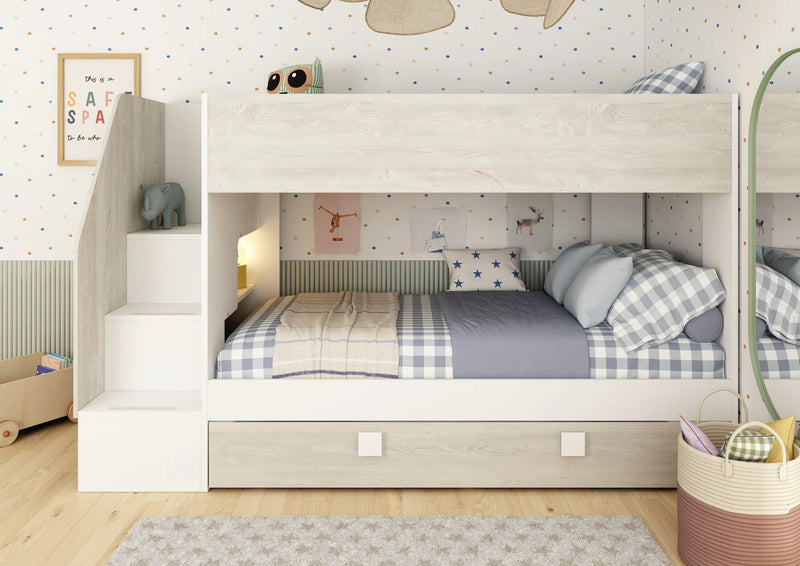
Picking between a loft bed and a bunk bed comes down to two questions: how many children need to sleep in the room, and what else that room needs to do. This guide covers the practical differences, safety rules, sizing, and storage options so you can match the right bed to your child's bedroom.
Loft Beds and Bunk Beds: Quick Answer for Busy Parents
A bunk bed is a single bed frame that stacks two sleeping areas vertically. Two children sleep in one footprint, one on the top bunk and one on the bottom bunk, with a ladder or steps connecting them and guard rails protecting the upper bunk.
A loft bed, often called a high sleeper bed in the UK, raises one mattress 150 to 180 cm off the floor and leaves the space underneath completely open. That space beneath the elevated bed frame can hold a desk, wardrobe, sofa, or play area. A high sleeper is, in practical terms, the same thing as a loft bed.
Here is a quick comparison:
-
How many children each sleeps: A bunk bed sleeps two (or three with a trundle). A loft bed sleeps one child with flexible space underneath.
-
Typical height from floor: Top bunk mattress sits around 130 to 160 cm high. High sleeper beds are 150 to 180 cm above the ground.
-
Best for: Bunk beds suit siblings sharing one room or regular sleepovers. Loft beds suit a single child who needs more space for study, storage, or play.
-
Key pros: Bunk beds stack two beds in one footprint. Loft beds maximize floor space by elevating the sleeping area and freeing the entire floor area below.
Choosing between loft beds and bunk beds depends on the number of sleepers and the room's intended use.
Millie & Jones is a UK, family-run children's bed specialist. We ask every manufacturer we work with to confirm the safety standards their beds are made to, and we hold that confirmation on file. Where a bed is certified to BS EN 747, the British standard covering guardrail height, gap sizes, ladder safety and structural strength, it says so on the product page. The rest of this article breaks down how to choose based on room size, your child's age, storage needs, and long-term use.
What Is a Bunk Bed?
A bunk bed is a bed frame that stacks two sleeping areas vertically, commonly taking 90 x 190 cm UK single mattresses, to maximise floor space in a child's bedroom. Bunk beds stack two beds vertically for multiple sleepers, making them a cost-effective solution compared to buying two separate beds and the furniture to fill a larger room.
The frame includes a top bunk, a bottom bunk, guard rails on the upper bunk, a ladder or steps, and slats that support each mattress. Bunk beds involve additional safety considerations like guardrails and ladders, so construction quality matters.
Common UK configurations include:
-
Single-over-single: Two 90 x 190 cm bunks stacked. The most common setup.
-
Single-over-small-double: A wider bottom bunk (120 or 135 cm) for an older sibling or parent during illness.
-
Triple sleeper with trundle: A pull-out under the lower bunk adds a third sleeping space for guests.
Bunk beds are ideal for shared rooms with limited space. They are suitable for siblings sharing a room or sleepovers, and work well in small three-bed semis where every square metre of living space counts. Bunk beds often include built-in storage options for functionality, such as built in drawers beneath the lower bunk. Bunk beds allow two sleeping spaces while maximizing floor area.
Parents often look for white bunk beds (bright, Scandi-feel), natural pine (classic warmth), or dark grey finishes (modern, hides scuffs). The bunk beds we sell are made for children and teens, with rounded edges, strong slats and robust construction for long-term use.
What Is a Loft Bed / High Sleeper Bed?
A loft bed, often called a high sleeper bed in the UK, is a raised single bed with the mattress around 150 to 180 cm from the floor, leaving open space underneath for other furniture or activities. A standard single mattress for high sleepers is 90 x 190 cm, the same size used in most UK children's beds.
High sleeper beds usually sleep one child but turn the room into a multi-functional zone. The space underneath becomes usable for desks, wardrobes, or seating. High sleepers are generally sturdy enough for teens as well as younger children. Where a manufacturer publishes a maximum user weight, it's stated on the product page.
Typical layout options under a loft bed include:
-
A full-length desk for homework or gaming, creating a dedicated study area
-
A wardrobe, drawers, and shelves for additional storage
-
A sofa bed for guests, which doubles as a chill out zone doubles-up as a reading nook
-
A play area or den for younger children
Millie & Jones offers options such as a white high sleeper with an integrated desk and wardrobe, or a dark grey gaming high sleeper with an extra-deep work surface. Loft beds free up floor space for additional furniture or activities, and loft beds provide open space underneath for desks or storage.
Loft beds work well in compact UK rooms with ceilings around 2.3 m or higher, where vertical space above the child's head goes unused. High sleeper beds are suitable for children aged 6 and over. Note that "high sleepers" differ from "mid sleepers": a mid sleeper bed lifts the mattress to about 110 to 140 cm and suits younger children, while full high sleepers and loft beds are for confident climbers aged 6 and up.
Loft Bed vs Bunk Bed: Key Differences at a Glance
The main difference between a loft bed and a bunk bed is what happens below the top bed. Here are the specifics:
-
Sleeping capacity: Bunk beds sleep two children (or more with trundles); a loft bed or high sleeper usually sleeps one but gives full utility underneath. If you always need two beds in the same room, a bunk bed is the answer.
-
Height: Bunk bed top mattress height typically ranges from 130 to 160 cm. High sleeper beds elevate the mattress 150 to 180 cm high, creating more room for a desk or wardrobe below.
-
Floor space usage: Bunk beds save space by stacking sleeping areas. Loft beds are generally better for maximizing usable floor space in smaller rooms because the whole footprint under the bed frame becomes available for desks, wardrobes, or seating. L-shaped bunk beds fit nicely into corners, maximizing space if your room layout allows it.
-
Flexibility over time: Loft beds are more flexible for future needs, changing from a play zone to a study area to a gaming station as the child grows. Bunk beds are fixed-purpose: they provide two sleeping spaces.
-
Room feel: Bunk beds can make a child's room feel cosy and cabin-like. High sleeper beds and loft beds can make it feel more open and studio-like, though loft beds can make a room feel darker due to the height of the bed blocking some overhead light.
-
Choosing between them: When deciding between a loft bed, a bunk bed, or a high sleeper, start with how many children need a sleeping space and whether the space underneath needs to serve as a desk, sofa, or play area.
Age Suitability and Safety: Matching the Bed to Your Child's Age
Age suitability and safety should come before style or colour when picking a raised bed. Safety standards recommend that children under 6 should not sleep on the top bunk of a bunk bed, and loft beds are not suitable for children under 6 years due to fall risks. BS EN 747 is the British and European standard that applies to raised beds, and it sets the age guidance for the upper sleeping area.
Clear age bands to follow:
-
Under 4 years: A standard single or toddler bed at floor level. No raised beds of any kind.
-
Around 4 to 5 years: A mid sleeper (mattress roughly 110 to 140 cm high) if the child is confident climbing ladders and has good coordination.
-
6 years and older: A full high sleeper, loft bed, or the upper bunk of a bunk bed, provided the child has good night-time awareness and does not sleepwalk.
Safety features to check before buying
-
Guard rails on all open sides of the top bed or high sleeper. The mattress surface must sit at least 16 cm below the top of the guard rail.
-
Gaps between rails and between the bed frame and wall that comply with BS EN 747 (no openings that could trap a child's head or limbs).
-
A sturdy ladder with non-slip steps, securely attached.
-
A maximum mattress depth of 15 to 16 cm for the upper sleeping area. Using a mattress deeper than 15 to 16 cm can reduce guardrail effectiveness because it raises the child above the barrier.
If your child sleepwalks, is restless, or has frequent night terrors, avoid high sleepers and top bunks until those patterns resolve. Parents should regularly tighten bolts, check guard rails for looseness, and teach children safe ladder use: no jumping from the top, one child on the ladder at a time.
We list age guidance and maximum mattress depth on every product page, and we ask each of our manufacturers to confirm the standards their beds are made to.
Room Size, Ceiling Height and Layout
Ceiling height is a critical factor when choosing a loft bed or bunk bed. A bed that leaves only 30 cm between the mattress and the ceiling will feel claustrophobic and prevent your child from sitting up safely.
High sleeper beds typically require a minimum ceiling height of 2.3 metres. The UK's Nationally Described Space Standard sets 2.3 m as the minimum floor-to-ceiling height for habitable rooms in new dwellings. With a high sleeper mattress at 150 to 180 cm and a 15 cm mattress on top, your child needs enough space above to sit upright without hitting their head. Bunk beds can sometimes work in rooms with lower ceilings than some high sleepers because the top bunk sits a little lower, but you still need safe clearance.
Practical measuring tips
-
Measure from floor to ceiling in the exact spot where the bed will stand; older UK houses often have uneven ceiling heights.
-
Measure wall to wall and allow at least 50 to 60 cm of clear space at the foot and side of the ladder for safe access.
-
Place the bed away from opening windows, radiators, and light fittings. Keep enough space around a desk or wardrobe under a high sleeper so the child can use it comfortably.
Example layout: In a small 2 m x 3 m child's bedroom in a UK terrace (6 m² of floor area), a loft bed with a desk underneath frees ample space for a wardrobe against the opposite wall. A bunk bed in the same room would eat into that wall space but gives you two beds for siblings. If only one child uses the room, the loft bed provides more room for other furniture. If two children share, the bunk bed is the only realistic option without sacrificing enough space to move around.
A well-planned child's bedroom, even a small one, can feel clutter-free and functional with the right bed and smart solutions for storage.
Storage, Study and Play: Making the Most of the Space
Both bunk beds and loft beds transform cluttered small rooms into organised spaces by using vertical space that would otherwise go to waste.
For loft beds and high sleepers
-
Integrated desks underneath provide a proper study area for homework or gaming
-
Built in storage such as wardrobes and shelving keep clothes, books, and gear off the floor
-
A sofa bed or pull-out beneath the frame creates a guest sleeping space or lounge
-
Open space under loft beds can be used for a desk or play area, depending on the child's age
High sleeper beds are a perfect fit for older children and older kids needing a proper workstation with room for a laptop, monitor, and textbooks. High sleeper beds create usable space underneath for desks or storage, and they provide space underneath for desks or storage solutions. High sleepers are built to hold up through the teen years.
For bunk beds
-
Under-bed drawers beneath the lower bunk add extra storage for toys and bedding
-
Pull-out trundles turn a two-sleeper bunk into a three-sleeper for guests
-
Headboard shelves keep bedtime books and water bottles within reach
Choosing between open space under a loft bed (for flexible, changeable use) and fully built in storage (for maximum organisation) depends on whether your child's needs are likely to shift. A 7-year-old's play area will become a 13-year-old's study desk.
White or light grey finishes brighten up the room and create a sense of more space. Dark grey metal or wood looks grown-up, suits teens, and hides scuffs. A typical Millie & Jones solution might be a high sleeper with wardrobe and desk for a 10-year-old who has outgrown a mid sleeper, or a bunk bed with built in drawers for two siblings sharing one bed frame's footprint.
Mid Sleeper vs High Sleeper vs Bunk Bed
Millie & Jones offers three main types of raised beds: mid sleepers, high sleepers (loft beds), and bunk beds. Each solves a different problem.
Mid sleeper beds place the mattress about 110 to 140 cm off the floor. The space beneath suits toy storage, a small pull-out desk, or a play den. They work for children roughly 4 to 10 years old and are a good cabin bed option for younger children who are not yet ready for a full high sleeper.
High sleeper beds place the mattress 150 to 180 cm high with full headroom underneath for a desk, wardrobe, or sofa. They suit confident climbers aged 6 and over and are the best seller category for older kids needing a proper workstation or extra space.
Bunk beds do one thing and do it well: two proper sleeping areas in one footprint. They are the right bed when you always need to sleep two children in the same room.
How to decide
-
If your child is younger and you want storage and a play zone, choose a mid sleeper.
-
If your older child or teen needs a workstation or gaming area, choose a high sleeper or loft bed.
-
If you need to sleep two children every night, choose a bunk bed.
Design, Materials and Colour Choices
The right design and finish help a loft bed or bunk bed sit naturally in a child's room rather than dominate it.
Common materials include solid pine and rubberwood for a warm, classic look; engineered wood (MDF, plywood) for affordability and consistent finishes; and metal bed frames for a slim, contemporary style popular with older kids. Solid wood holds up better at high-stress joints and can be sanded and refinished.
Finishes and colours to consider
-
White for bright, Scandi-style rooms
-
Oak effect for cosy, natural spaces
-
Dark grey and light grey for modern, gender-neutral rooms that grow with your child
Practicalities matter: easy-clean surfaces, durable paint, rounded corners, and responsibly sourced timber. The designs we choose are deliberately timeless rather than themed, so a high sleeper purchased for an 8-year-old still looks right in a teenager's room years later.
Styling tips: add LED clip-on lights to the desk area, storage boxes under the lower bunk or mid sleeper, and coordinated bedding to tie the whole sleeping area together.
Choosing the Right Bed with Millie & Jones
There is no single "best" option. The right loft bed, high sleeper, or bunk bed depends on your child's age, how many sleepers you need to accommodate, and the size of the room.
Key decision points
-
Your child's age and confidence level on ladders
-
Number of children using the room and how often guests stay over
-
Ceiling height and available floor area
-
Need for built-in storage, a study desk, or gaming space
Consider future needs: will the bed still suit your child in 3 to 5 years? A loft bed that starts as a play den can become a study area; a bunk bed that serves two siblings now can have its lower bunk removed later for extra space.
Millie & Jones delivers across mainland UK, with detailed assembly instructions and a customer support team ready to help you pick the right bed type. Browse the Millie & Jones collections of bunk beds, loft beds, high sleeper beds, and mid sleepers, or contact the family team for tailored advice based on your child's age and room measurements.